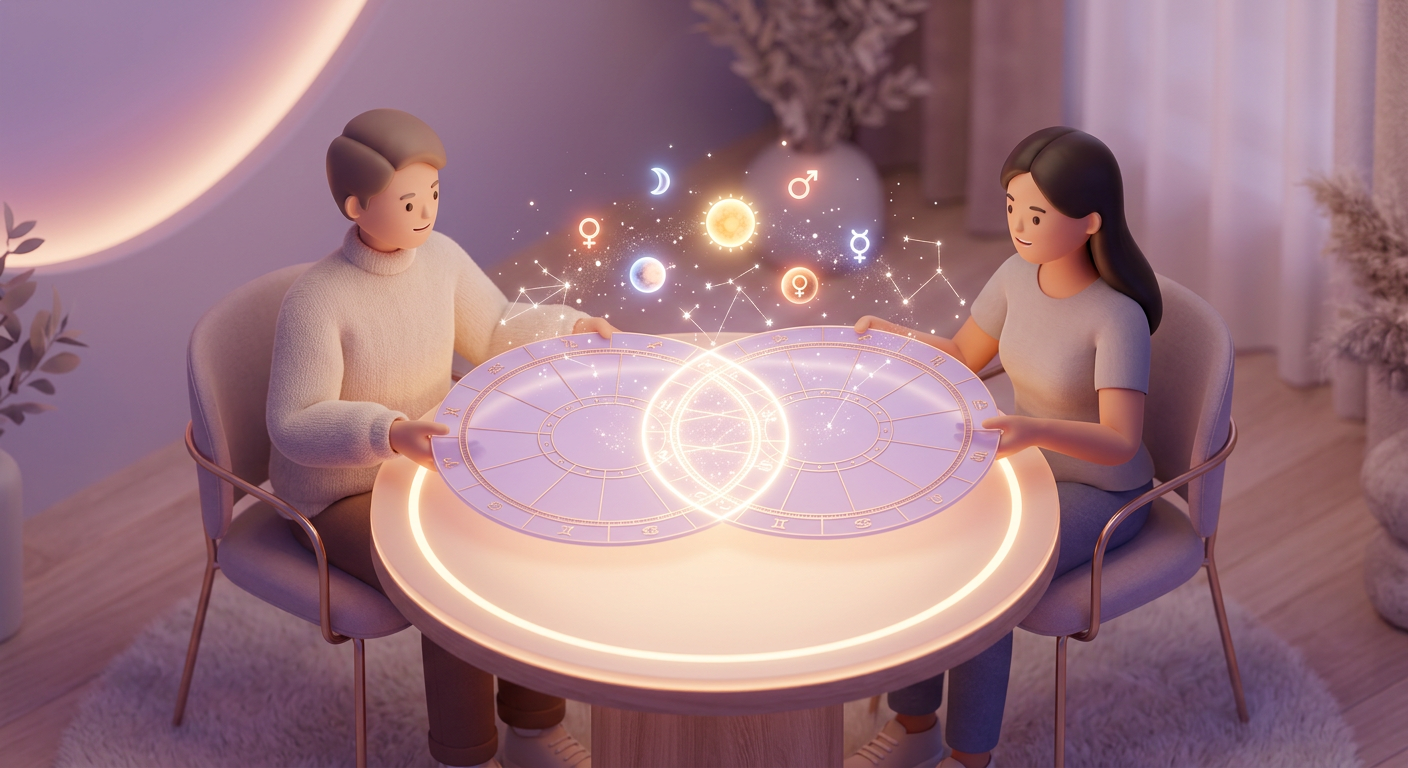
Most people approach synastry like they're grading a test. Count the trines, subtract the squares, check if Venus touches Mars, and declare a compatibility score. I've watched this approach miss the point so spectacularly that couples with 'bad' synastry end up thriving, while people with textbook-perfect charts can't make it six months.
Here's the thing — synastry chart interpretation is less about tallying aspects and more about reading the story those aspects tell together. It's a qualitative analysis, not a math problem. And once you understand the actual methodology behind a structured reading, you'll never look at a compatibility checklist the same way again.
This guide walks you through that methodology. We'll cover what synastry actually measures, how to set up and prioritize your analysis, and when to bring in the composite chart for a fuller picture. Whether you're new to this or you've been reading charts for years and want to sharpen your process, there's something here for you.
What Synastry Actually Shows (and What It Doesn't)
Synastry measures the interaction between two natal charts. You're looking at how one person's planetary placements aspect another person's placements — and what that dynamic feels like for both people involved.
But it's worth being clear about what synastry doesn't show.
The Difference Between Synastry and a Composite Chart
Synastry is two separate people placed in relationship with each other. The composite chart is something different — it's a mathematically derived chart that represents the relationship itself as a third entity. Think of it this way: synastry shows the chemistry between two people; the composite shows the nature of the bond they create together.
For a thorough exploration of when to use each method, composite chart vs synastry: which method to use for relationship longevity breaks this down in serious depth. The short version: you need both. Synastry without the composite misses the relationship's identity. Composite without synastry misses the interpersonal friction (and magnetism) that drives it.
Why Two People Can Have Strong Synastry but a Difficult Relationship
Strong synastry — especially when it involves outer planets hitting personal planets — creates intensity. Intensity isn't the same as compatibility. A Pluto-Venus conjunction in synastry is magnetic and transformative. It's also frequently obsessive and destabilizing. Two people can be profoundly drawn to each other and simultaneously terrible for each other's growth.
Synastry shows the pull. What you do with that pull is a free-will question synastry can't answer.
Common Misconceptions About Synastry Interpretation
Myth 1: More Trines = Better Relationship
This is probably the most persistent myth in amateur astrology circles. Trines are easy energy — supportive, flowing, comfortable. But relationships that are only trines tend to feel pleasant and... flat. There's no friction to create growth, no tension to keep two people genuinely engaged. In my experience reading charts, the most lasting partnerships almost always have a healthy dose of squares and oppositions alongside the harmonious aspects.
Myth 2: Sun Sign Compatibility Is the Foundation
Sun-Sun aspects matter, but they're nowhere near the top of the priority list. If your Suns are square but your Moons trine and your Venus conjuncts their Mars, you're going to feel compatible even if the surface-level 'zodiac compatibility' looks rough. Sun sign compatibility is only 10% of the picture — and that's being generous.
Myth 3: One Bad Aspect Is a Red Flag
Context is everything. A single Saturn square Venus in synastry sounds harsh. In a chart where Venus is otherwise well-supported and the composite shows strong 7th house emphasis, that Saturn aspect adds structure and commitment, not just burden. You can't read aspects in isolation — ever.
Setting Up Your Synastry Chart: What You Need
Birth Data Requirements and Why Accuracy Matters
You need the full birth data for both people: date, time, and location. The birth time is non-negotiable if you want to work with house overlays and angle contacts — which, as you'll see, are some of the most revealing factors in the whole chart. An unknown or approximate birth time means you're working without the ascendant and house cusps, which is like reading a book with every third chapter missing.
Even a 15-minute error in birth time can shift house cusps significantly and change which planets fall in which houses. If someone doesn't know their birth time, encourage them to check their birth certificate or contact the relevant records office. (Yes, this is worth the effort. I promise.)
Bi-Wheel vs. Overlay: Understanding the Visual Format
A bi-wheel chart is the standard visual format for synastry. Person A's chart forms the inner wheel; Person B's planets are placed in the outer ring around it. This lets you see immediately which of Person B's planets fall in which of Person A's houses, and which aspects form between the two sets of planets.
Some astrologers prefer working with two separate charts side by side, but the bi-wheel format is far more efficient for spotting patterns quickly. Most good synastry tools will generate this for you automatically — and if you want to run your synastry chart with detailed interpretation, you can get both the bi-wheel and the aspect grid in one place.
The Hierarchy of Synastry Factors: What to Read First
This is where most guides fall down. They give you a flat list of aspect meanings with no sense of priority. Here's the actual hierarchy I use:
Personal Planet Contacts: Sun, Moon, Venus, Mars, Mercury
These are your first-tier factors, full stop. Personal planets represent core aspects of each person's identity and drive. When they contact each other across charts, the interaction is felt directly and personally.
- Moon synastry is the king of emotional compatibility. How Person A's Moon interacts with Person B's Moon, Sun, and Venus tells you more about long-term emotional resonance than almost anything else in the chart. A Moon-Moon trine creates a sense of effortless emotional understanding. Moon-Saturn aspects create a bond that feels serious but can also feel restrictive. If you read nothing else in a synastry chart, read the Moons.
- Venus-Mars synastry is the classic attraction signature. Venus person feels adored; Mars person feels pursued. When these two planets aspect each other — especially by conjunction or trine — there's a natural pull that's hard to ignore. For a deeper look at this dynamic, Venus and Mars compatibility: the astrology of attraction and desire is worth reading alongside this guide.
- Mercury contacts are underrated. They determine whether two people actually enjoy talking to each other — the communication texture of the relationship. A Mercury square can manifest as constant misunderstandings or stimulating debate, depending on everything else in the chart.
Angle Overlays: ASC, DSC, MC, IC Connections
This is second-tier but comes close to first in importance. When one person's planet conjuncts another person's Ascendant, Descendant, Midheaven, or IC, the effect is immediate and personal. These points are the most sensitive parts of the chart.
ASC overlays in particular create a strong physical and first-impression magnetism. The planet person often embodies what the ASC person finds attractive or interesting. If someone's Venus conjuncts your ASC, they probably find you genuinely beautiful — and you probably feel seen by them in a unique way.
The IC (4th house cusp) overlay is one of the most intimate contacts in synastry. When someone's planet sits on your IC, they reach something deep, private, and foundational in you. This can feel profoundly nurturing or deeply destabilizing, depending on the planet involved.
Outer Planet Overlays: Generational or Personal?
Outer planets — Jupiter, Saturn, Uranus, Neptune, Pluto — move slowly. People born within a few years of each other will have similar outer planet placements, which means many outer-planet-to-outer-planet aspects in synastry are generational, not personal. Don't over-read them.
What does matter is when outer planets hit personal planets or angles. Saturn conjunct someone's Moon in synastry is deeply personal. Neptune opposite someone's Venus is deeply personal. These contacts carry weight because they're activating a personal point. Pluto trine Pluto between two people born three years apart? Mostly generational noise.
Interpreting the Most Common Synastry Aspects
Conjunctions: Magnetic Pull and Merged Energy
Conjunctions are the most powerful aspect in synastry. Two planets in the same degree merge their energies — and in a relationship context, this creates an immediate sense of recognition and intensity. The nature of the conjunction depends entirely on which planets are involved. Sun-Moon conjunctions feel fated and deeply bonding. Mars-Saturn conjunctions can feel controlling or inhibiting.
Trines and Sextiles: Ease That Can Lack Tension
Harmonious aspects flow naturally. There's no friction, no challenge — things just work. The catch is that ease can breed complacency. A relationship built primarily on trines and sextiles may feel wonderful but lack the dynamic tension that keeps both people growing. These are genuinely positive aspects; just don't mistake 'comfortable' for 'deep.'
Squares and Oppositions: Growth Through Friction
Here's where most people get it wrong. Squares create tension, yes — but tension creates engagement. When Person A's Sun squares Person B's Moon, there's a friction between how Person A expresses themselves and what Person B emotionally needs. That friction is uncomfortable. It's also the thing that makes both people work harder, communicate more, and ultimately grow.
Oppositions work similarly but with a magnetic polarity twist — you're drawn to exactly what challenges you. Studies of long-term couples' charts consistently show a higher-than-average incidence of squares and oppositions in synastry. Strong Saturn aspects in synastry is a great companion read on how the 'hard' aspects actually build durability.
House Overlays: Where Your Partner Activates Your Life
House overlays are one of the most revealing — and most frequently skipped — parts of synastry analysis. When Person B's planet falls in one of Person A's houses, it activates that area of Person A's life. The planet brings its energy to that house's themes.
5th House Overlays: Romance and Playfulness
When someone's planets fall in your 5th house, they bring fun, romance, and creative energy into your life. Venus in the 5th overlay is classic romantic chemistry — this person makes you feel flirtatious, playful, creative. Even Sun in the 5th overlay creates a sense of being genuinely entertained and celebrated by this person. These overlays often indicate strong initial attraction and a relationship that feels exciting and alive.
8th House Overlays: Intensity and Transformation
The 8th house is where things get complicated. Planets falling here bring intensity, depth, and a sense of transformation — but also power dynamics, obsession, and vulnerability. A Venus in your 8th overlay means this person reaches something deep and private in you. The attraction is profound but not always comfortable. Pluto in the 8th overlay is the classic 'I can't stop thinking about this person' energy — magnetic, consuming, and often karmic in texture.
For relationships where 8th house overlays are prominent, it's worth also reading about karmic relationships in astrology to understand what that intensity might be pointing toward.
Practical Tactics for Synastry Analysis
| Technique | Best Use | Outcome |
|---|---|---|
| Moon-to-Moon aspect check | First step in emotional compatibility | Reveals baseline emotional resonance or friction |
| Personal planet to angle overlays | Assessing magnetism and recognition | Identifies why two people feel immediately drawn to each other |
| Venus-Mars cross-aspects | Romantic and sexual attraction baseline | Shows who pursues, who attracts, and how desire flows |
| House overlay mapping | Understanding activation patterns | Reveals which life areas light up in each person's presence |
| Aspect pattern counting | Identifying dominant themes | Repeated themes across multiple aspects confirm what's real |
| Saturn and Nodal contacts | Long-term potential and karmic connection | Flags whether the relationship has durability or a 'lesson' quality |
| Composite chart cross-reference | Validating synastry findings | Confirms whether the bond itself supports what the synastry suggests |
Synthesizing the Full Synastry Picture: A Step-by-Step Workflow
Okay, so here's where interpretation actually happens. Most guides give you a list of aspect meanings and leave you to figure out synthesis yourself. I'm going to give you the actual workflow.
Step 1: Check the Moons first. Moon-to-Moon, Moon-to-Sun, Moon-to-Venus. These three contacts set the emotional foundation for everything else. If the Moons are in a hard square with no supportive contacts elsewhere, everything in this relationship will feel emotionally effortful, regardless of how good the rest of the chart looks.
Step 2: Identify the angle contacts. Any planet conjunct the ASC, DSC, MC, or IC within 3-4 degrees deserves significant weight. These are the 'felt immediately' contacts.
Step 3: Map the Venus and Mars contacts. Venus-Mars cross-aspects tell you about attraction and desire. Venus-Venus aspects tell you about shared values and aesthetic connection. Mars-Mars aspects tell you about how two people's drives either align or compete.
Step 4: Note the house overlays. Where are each person's personal planets landing in the other's chart? A cluster of planets in someone's 7th house suggests this person strongly activates partnership themes. A cluster in the 12th suggests something more hidden and spiritually complex.
Step 5: Look for repeating themes. This is the synthesis step. If Saturn squares someone's Venus AND Saturn also opposes their Moon AND Saturn falls in their 7th house overlay, Saturn is a dominant theme. That's a relationship with serious commitment energy — possibly restrictive, possibly stabilizing, but definitely significant. Single aspects lie. Themes tell the truth.
Step 6: Read the composite chart. Once you've understood the synastry dynamics, move to the composite to understand the relationship's independent nature. For a structured approach to this, the beginners guide to reading a composite chart is a clean starting point.
Measuring Success: What 'Good' Synastry Actually Looks Like
Let's talk benchmarks, because this comes up constantly.
Emotional compatibility baseline: At least 2-3 supportive Moon contacts (Moon trine Moon, Moon conjunct Venus, Moon sextile Sun) suggests the emotional foundation is workable. This doesn't mean zero hard aspects — it means the hard aspects have something solid to work against.
Attraction indicators: One strong Venus-Mars cross-aspect (especially conjunction or trine) is enough to establish real romantic pull. You don't need five.
Durability signals: Research into long-term couples consistently shows Saturn contacts in synastry — particularly Saturn conjunct or trine the Sun, Moon, or Venus of the other person. These aspects add weight, responsibility, and staying power to a connection. According to astrological research compiled across multiple relationship studies, Saturn contacts appear in approximately 70% of long-term committed partnerships' synastry charts.
Red flag threshold: Any single aspect isn't a red flag. A pattern of hard aspects with no supportive counterbalance — particularly involving outer planets hitting personal points — warrants careful attention. Pluto-Moon hard aspects with no supportive Moon contacts elsewhere, combined with 8th and 12th house overlays dominating the chart? That's a pattern worth thinking seriously about.
Future Trends in Synastry Analysis
The field is genuinely evolving. A few things worth tracking:
Asteroid integration. More practitioners are incorporating asteroids like Juno, Chiron, and Vertex into synastry readings. Juno in particular — as the asteroid of committed partnership — has shown up in interesting ways in long-term couples' charts. Saturn, North Node, and Juno: the three placements that predict whether a relationship lasts is a good read on this emerging area.
Progressed synastry. Using progressed charts (where each day after birth equals one year of life) in synastry adds a time dimension — showing how the relationship dynamic shifts as both people grow. This is a more advanced technique but increasingly popular among serious practitioners.
Data-driven validation. There's growing interest in applying statistical analysis to large datasets of couples' charts to validate which synastry factors actually correlate with relationship longevity. Early findings (still preliminary) suggest Moon contacts and Saturn aspects are the most statistically significant — which aligns with traditional interpretive wisdom.
AI-assisted interpretation. Tools are getting better at generating nuanced, contextualized synastry readings rather than just listing aspect meanings. The gap between a good human reading and a good automated reading is narrowing faster than most practitioners want to admit. (Not gone yet — but narrowing.)
When to Move From Synastry to the Composite Chart
Here's the practical answer: move to the composite when you've finished your synastry analysis and want to understand the relationship's own identity and trajectory.
Synastry tells you about the people. The composite tells you about the relationship. You need both because they answer different questions. A couple can have intense, electric synastry and a composite chart with a difficult 12th house Sun — which suggests the relationship, however magnetic, operates in secret, isolation, or self-undoing patterns. That's crucial information that synastry alone won't give you.
For marriage and long-term commitment indicators specifically, composite chart marriage indicators and placements covers the composite factors that show up most consistently in couples who actually build lasting lives together.
And if you want to understand the foundational question of which tool to prioritize and when, the parent resource on composite chart vs synastry: which method to use for relationship longevity covers the full decision framework.
Where to Go From Here
Synastry interpretation rewards patience and layered thinking. The readers who get the most out of it are the ones who resist the urge to reduce a relationship to a score.
Start with the Moons. Build out through the personal planets. Check the angles. Map the house overlays. Look for repeating themes. Then cross-reference with the composite. That's the methodology — and it works.
If you want to put this into practice right now, run your synastry chart with detailed interpretation and work through the aspects using the hierarchy and workflow outlined here. The chart is the starting point. The interpretation is where the real understanding begins.