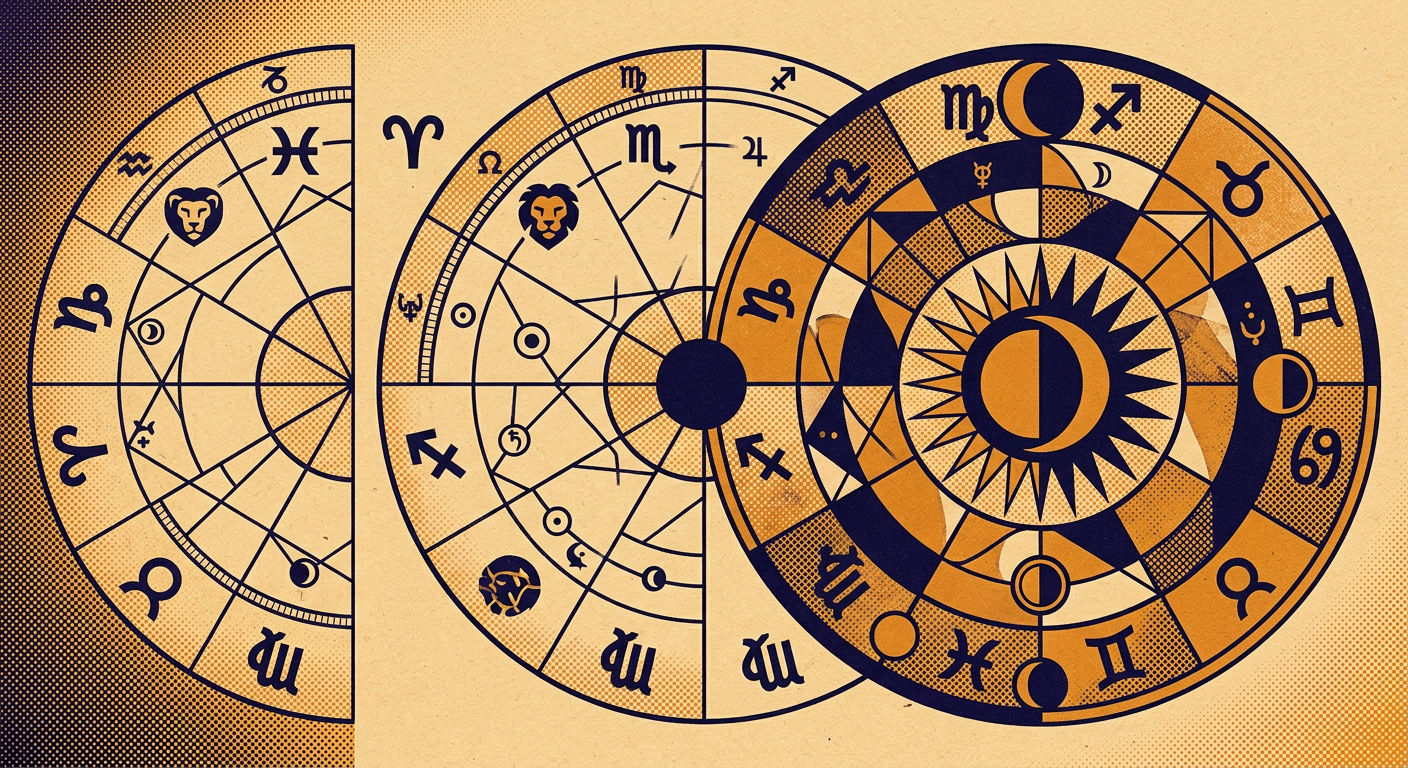
You've pulled up two birth charts, you've stared at the synastry grid, and now someone mentions a composite chart and you freeze. What even is that wheel? Is it one of their charts? Both? Neither?
Here's the thing — that confusion is completely normal, and it's actually a sign you're asking the right question. Because a composite chart isn't what most beginners assume it is. It's not a mashup of two people's personalities. It's something stranger and more interesting than that: a portrait of the relationship itself.
In this guide, I'm going to walk you through how to read a composite chart from scratch. We'll cover what you're actually looking at, which placements to read first, how the houses work, and the most common mistakes beginners make. By the end, you'll have a real framework — not just a list of planet keywords — for making sense of any composite chart you encounter.
What Is a Composite Chart and Why Does It Matter?
A composite chart is a single horoscope created for a relationship rather than for a person. It describes the partnership as its own entity — with its own identity, emotional tone, communication style, and purpose in the world.
This is a genuinely different thing from looking at two natal charts side by side.
The Midpoint Method Explained Simply
The most common technique for generating a composite chart is the midpoint method. Here's the simple version: you take each planet's position in Person A's chart and each planet's position in Person B's chart, then calculate the exact midpoint between them. Do that for every planet, the Sun, the Moon, the Ascendant, and the major angles — and you have your composite chart.
So if Person A has their Sun at 10° Aries and Person B has their Sun at 20° Gemini, the composite Sun would land somewhere around 15° Taurus. That composite Sun position doesn't belong to either person. It belongs to the relationship.
(There's also a Davison chart method that uses actual midpoint dates and locations — but for beginners, the midpoint composite is the standard starting point.)
How a Composite Chart Differs From Two Separate Natal Charts
This is where most beginners get tripped up. When you look at a natal chart, you're reading a person's psychology — their inner world, their drives, their patterns. When you look at a composite chart, you're reading something external to both individuals.
The composite chart describes what happens between two people. It shows the energy field the relationship generates, the themes that keep surfacing no matter how self-aware both partners are, and the purpose the relationship seems to serve in both their lives.
For a deeper look at how composite and synastry analysis compare — and when to use each — check out composite chart vs synastry: which reveals relationship longevity. That article does a great job of framing the two techniques as complementary rather than competing.
The Core Building Blocks: Planets, Signs, and Houses in a Composite
Before you start reading specific placements, here's the interpretive frame that changes everything: in a composite chart, the relationship is the subject. Not you. Not your partner. The relationship.
So when you read "composite Sun in Scorpio," you're not saying either person is Scorpio-like. You're saying the relationship itself has a Scorpionic nature — it tends toward depth, intensity, transformation, and emotional excavation.
Keep that reframe in your head as we go through the key placements.
The Composite Sun: The Relationship's Core Identity
Start here. Always.
The composite Sun is the relationship's core purpose and public identity. It answers the question: What is this relationship fundamentally about? A composite Sun in the 3rd house says the relationship thrives on communication, intellectual exchange, and shared ideas. A composite Sun in the 10th house suggests the partnership has a public or career-oriented dimension — maybe you build something together that the world sees.
The sign matters, but the house placement often matters more in composite work. I think of the composite Sun's house as the relationship's "home base" — the terrain where it's most alive and most itself.
The Composite Moon: Emotional Tone of the Partnership
If the composite Sun is the relationship's identity, the composite Moon is its emotional weather. It describes how the relationship feels from the inside — the mood, the comfort level, the instinctive responses that arise when both people are together.
A composite Moon in Capricorn, for example, suggests the emotional tone is somewhat reserved and practical. These two people may not be dramatic with each other — they show care through reliability and structure. A composite Moon in Cancer, by contrast, creates a relationship that feels like home: nurturing, emotionally permeable, and deeply private.
When the composite Sun and Moon are in harmony (same element, or in a supportive aspect), the relationship tends to feel coherent — its identity and emotional life point in the same direction. When they're in tension, there's often a disconnect between what the relationship projects publicly and how it actually feels behind closed doors.
Composite Venus and Mars: Love Language and Physical Chemistry
Composite Venus describes how the relationship expresses affection, what it values, and what brings it pleasure. Think of it as the relationship's love language. Composite Venus in Gemini? This partnership thrives on witty banter, novelty, and intellectual flirtation. Venus in Taurus? Slow, sensual, and deeply grounded in shared physical comfort.
Composite Mars is the relationship's drive and physical chemistry. It shows how the partnership takes action, handles conflict, and expresses desire. A composite Mars in a fire sign tends toward passionate, sometimes heated dynamics. Mars in Libra might mean the relationship approaches conflict diplomatically — sometimes too diplomatically, avoiding necessary confrontations.
And here's something worth noting: composite Venus and Mars don't always align neatly, which is fine. Tension between them can actually create a kind of productive friction that keeps both people engaged.
Reading the Composite Chart's Houses: Where the Relationship Lives
The houses in a composite chart tell you where the relationship's energy lands — which life domains it activates, which areas it struggles with, and which themes keep returning no matter how much time passes.
1st House: How the Relationship Presents to the World
Planets in the composite 1st house shape the relationship's outward personality — how it comes across to others, how it initiates, and what energy it radiates. A composite Ascendant in Sagittarius with Jupiter conjunct it suggests the relationship has an expansive, adventurous quality that others immediately sense. These two people probably seem fun and larger-than-life together, even if individually they're more reserved.
7th House: Commitment and Partnership Dynamics
The 7th house in a composite chart is fascinating because it describes the relationship's relationship to commitment itself. Planets here often show what the partnership is working through in terms of balance, negotiation, and long-term agreement. Saturn in the composite 7th, for instance, suggests a relationship that takes commitment seriously — sometimes to the point of feeling weighty, but also with real staying power.
8th and 12th Houses: Hidden Intensity and Sacrifice
These houses tend to make beginners nervous. But they're not warning signs — they're depth indicators.
Planets in the composite 8th house describe shared intensity: emotional transformation, financial entanglement, psychological depth, and the kind of intimacy that changes both people. A composite Moon in the 8th is one of the most emotionally bonding placements you can find.
The composite 12th house is about what the relationship keeps hidden — from the world, and sometimes from the partners themselves. Planets here can indicate a spiritually significant bond, a relationship that requires some sacrifice, or one that has a private, almost otherworldly quality. It's also associated with past-life connections in some interpretive traditions. (If that angle interests you, karmic relationships in astrology explores those themes in real depth.)
Key Aspects to Prioritize in a First-Pass Composite Reading
Aspects are the angular relationships between planets in the composite chart. They show how the relationship's various energies interact with each other. For beginners, I'd strongly recommend focusing on just two categories to start.
Conjunctions: Where Energy Merges
A conjunction (two planets within about 8°) in a composite chart is where two energies have fused into one undivided force. This is almost always significant, regardless of which planets are involved.
Composite Sun conjunct Jupiter? The relationship has an inherently expansive, optimistic quality — things tend to feel bigger and more possible together. Composite Moon conjunct Saturn? Emotional security is earned slowly, and both people may feel a serious, somewhat cautious emotional bond.
Look for conjunctions first in any composite chart. They're your loudest signals.
Squares and Oppositions: Built-In Friction Points
Squares (90° apart) and oppositions (180° apart) describe the relationship's built-in tension points. These aren't dealbreakers — every meaningful relationship has them — but they do show where the partnership will require the most conscious effort.
A composite Venus square Mars, for instance, suggests attraction and friction are intertwined. The chemistry is real, but so is the potential for conflict around desire and values. An opposition often shows a push-pull dynamic: the relationship oscillates between two poles and needs to find a middle ground.
So don't panic when you see squares. They're often what makes a relationship interesting and growth-oriented rather than stagnant.
Common Mistakes Beginners Make When Interpreting Composite Charts
I've seen these come up again and again, and I want to save you the detours.
Reading the composite as a description of one person. This is the most common error. The composite chart is not your chart or your partner's chart. It belongs to the relationship. When you read "composite Moon in Pisces," you're not saying either person is Piscean — you're saying the emotional tone of the relationship has a Piscean quality.
Starting with aspects before reading the Sun and Moon. Beginners often jump straight to "Oh, we have a Mars square Saturn — that's bad!" without first establishing the relationship's foundational identity. Read the composite Sun, Moon, Venus, and Mars first. Aspects only make sense in that context.
Treating challenging placements as predictions of failure. A composite chart with the Sun in the 12th house or Saturn conjunct the Moon is not doomed. These placements describe challenges and textures — they don't determine outcomes. How two people choose to work with their composite chart matters enormously.
Ignoring the houses entirely. Some beginners just read sign placements and skip houses. Don't. In composite work, the house a planet occupies often tells you more than the sign it's in. A composite Sun in Aries in the 12th house behaves very differently from a composite Sun in Aries in the 1st.
Using only the composite chart in isolation. The composite chart shows the relationship's character. But to understand how two people actually experience each other — the personal triggers, the attraction mechanics, the communication style — you also need synastry. For a structured approach to that side of the analysis, how to read a synastry chart for beginners is a great companion read.
How Composite Chart Reading Connects to the Broader Synastry Picture
Here's how I think about the relationship between these two tools: synastry shows you the conversation between two people, while the composite chart shows you the entity that conversation creates.
Both are necessary for a complete picture. You might have gorgeous synastry — lots of harmonious planet overlays, strong Venus-Mars contacts, flowing trines — but a composite chart that points to significant karmic tension or a 12th-house heavy emphasis that keeps the relationship hidden or unresolved. Or the reverse: challenging synastry overlays but a composite chart with a beautifully integrated Sun-Moon-Venus configuration that suggests the relationship, as a unit, has remarkable coherence.
For a structured comparison of what each technique reveals — and which to prioritize depending on what you're trying to understand — the best composite chart calculator tools article is worth bookmarking. It also walks through how different platforms generate and display composite data, which matters more than you'd think when you're first learning.
And if you're ready to see these concepts applied to an actual chart right now, generate your free composite chart with interpretation — it's the fastest way to move from theory to real practice.
One more thing worth mentioning: composite chart reading gets richer when you understand the broader compatibility framework it sits within. For instance, the way Venus and Mars compatibility works in synastry often echoes — and sometimes contrasts with — how composite Venus and Mars express themselves. That interplay between the two systems is where the real interpretive depth lives.
For a fully layered reading, the synastry chart interpretation guide walks through how to integrate composite findings with synastry overlays into a coherent overall picture. That's where beginner interpretation ends and real astrological literacy begins.
Your Next Step
Pull up a composite chart — yours with a partner, a close friend, or even a past relationship you're trying to understand. Find the composite Sun and Moon first. Write down the sign and house for each. Then ask yourself: does the emotional tone (Moon) support the relationship's identity (Sun), or is there a gap between them?
That single question will teach you more about composite chart reading than any keyword list. Start there, be patient with yourself, and let the chart reveal its layers one at a time. The relationship is trying to tell you something. You're just learning its language.