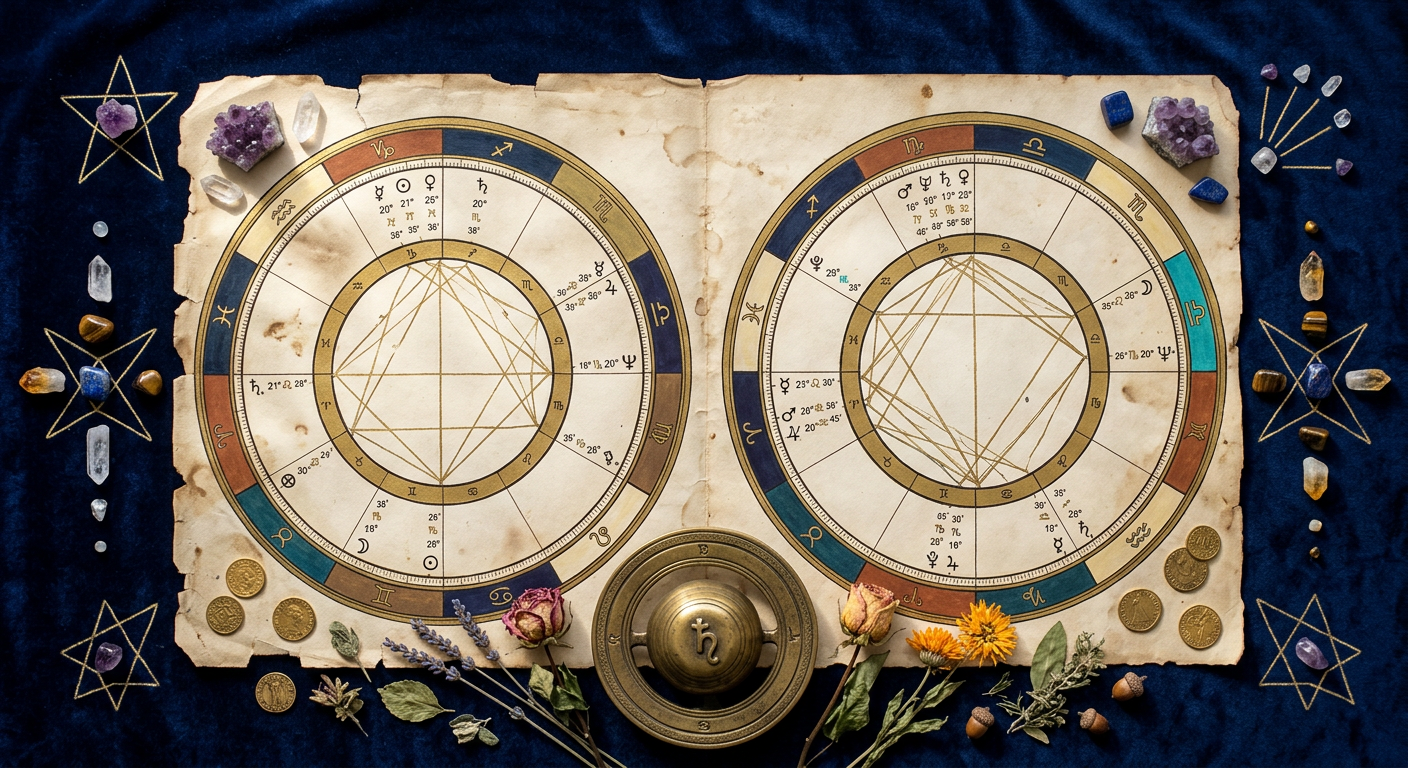
Why Saturn Aspects in Synastry Are Not Created Equal
Saturn gets a reputation as the heavy in astrology — the planet of restriction, delay, and obligation. But in synastry, it's actually one of the most sought-after placements for people who want something real. The catch? Not every Saturn aspect delivers the same flavor of "real."
Some Saturn connections create genuine, lasting commitment — the kind where two people genuinely choose each other year after year. Others create what I'd call obligation glue: you stay, but not because it feels good. You stay because leaving feels impossible. And honestly, those two experiences can look identical from the outside, especially in the early years of a relationship.
So before you celebrate (or panic) about a Saturn aspect in your synastry chart, it's worth understanding which aspect you're dealing with, whose Saturn is involved, and what the rest of the chart is saying. The difference between a relationship that lasts because it's fulfilling and one that lasts because it's heavy — that distinction matters enormously.
This is exactly why understanding how Saturn, North Node, and Juno together predict relationship longevity gives you a much fuller picture than any single aspect can.
Common Misconceptions About Saturn in Synastry
Myth 1: Any Saturn aspect means the relationship will last.
This is the most widespread oversimplification. Saturn aspects do correlate with longevity in relationships, but longevity isn't the same as happiness or health. A Saturn square Moon aspect, for instance, can keep two people together for decades — through emotional suppression, guilt, and a creeping sense that one person is never quite good enough. That's duration, not destiny.
Myth 2: Hard Saturn aspects are bad, soft ones are good.
Here's the thing — this is almost backwards in practice. Trines and sextiles from Saturn feel comfortable, even easy. But "easy" Saturn sometimes lacks the binding intensity that makes couples stay through the hard seasons. Squares and oppositions create friction, yes, but friction also creates grip. Many long-term couples have hard Saturn aspects and credit the tension as the very thing that kept them growing.
Myth 3: Saturn aspects only matter when Saturn is the outer planet.
The direction of the aspect matters — whose Saturn touches whose personal planet changes the dynamic significantly. When your Saturn falls on your partner's Moon, you're the one doing the structuring (and potentially the suppressing). When their Saturn falls on your Moon, you're the one feeling constrained. Same aspect, very different lived experience.
The Hierarchy of Saturn Aspects: From Glue to Grind
Not all Saturn interaspects are created equal. Here's how I rank the major ones by their real-world relationship outcome — from the aspects most likely to build genuine, fulfilling longevity to those that tend toward obligation without joy.
Saturn Conjunct Sun: Authority and Identity Tension
This is one of the most complex Saturn aspects in synastry. The Saturn person often feels a deep sense of responsibility toward the Sun person — and the Sun person may initially experience this as attractive stability. But over time, the Sun person can start to feel dimmed. Their spontaneity, their self-expression, their basic identity gets quietly managed.
When it works, this aspect creates a relationship where the Saturn person genuinely helps the Sun person mature and build something lasting. When it doesn't, the Sun person slowly shrinks. The key differentiator is whether the Saturn person's influence feels supportive or controlling — and that's heavily shaped by Saturn's sign and the overall chart context.
Longevity potential: High. Fulfillment potential: Variable.
Saturn Conjunct Moon: Emotional Gravity and Real Commitment
Of all the Saturn aspects in synastry, this one carries the most emotional weight — literally. The Moon person's feelings, needs, and emotional rhythms become the Saturn person's project. At best, the Saturn person provides the Moon person with exactly the kind of emotional security they've always needed: consistent, reliable, present. At worst, the Moon person feels emotionally policed.
Research into long-term couple charts consistently surfaces this aspect. It's one of the most common Saturn connections found in marriages that last 20+ years. But I want to be clear: duration isn't always the goal. If the Moon person spends two decades feeling like their emotions are too much, too messy, or inconvenient — that's not a love story, that's endurance.
Longevity potential: Very high. Fulfillment potential: Depends entirely on Saturn's maturity.
Saturn Trine Venus: The Aspect That Quietly Sustains Romance
If I had to pick one Saturn aspect that most reliably produces both longevity and genuine warmth, it's Saturn trine Venus. The trine keeps Saturn's stabilizing energy from becoming oppressive — it flows. The Venus person feels appreciated and grounded rather than restricted. The Saturn person feels genuinely attracted and committed rather than obligated.
This is the aspect that shows up in couples who, 15 years in, still genuinely like each other. Not just love — like. There's a steady affection here that doesn't burn hot but doesn't burn out either. And because Venus rules both romance and values, this trine often means the couple shares a fundamental alignment in what they want from life.
For anyone curious about how Venus and Mars energy layers into this, Venus and Mars Compatibility: The Astrology of Attraction and Desire is worth reading alongside your Saturn analysis.
Longevity potential: High. Fulfillment potential: High.
Saturn Square Mars: Friction That Forges or Fractures
Saturn square Mars is the aspect that keeps astrologers up at night — and for good reason. Mars is drive, desire, action, sexuality. Saturn is restriction, delay, structure. When these two square off in synastry, you get a relationship where someone's energy is constantly being checked, slowed, or criticized.
But here's where it gets interesting. Some of the most driven, high-achieving couples have this aspect. The friction becomes productive. The Mars person pushes; the Saturn person focuses that push. The result can be extraordinary — if both people are mature enough to work with it rather than against each other.
When it breaks down, it looks like chronic frustration, power struggles, and a Mars person who feels perpetually blocked. The Saturn person may not even realize they're doing it — it can be unconscious.
Longevity potential: Medium-high (the tension keeps people engaged). Fulfillment potential: Highly variable.
Saturn Opposite Jupiter: Expansion vs. Contraction in Partnership
This opposition creates a fascinating push-pull that can either balance beautifully or exhaust both people. Jupiter wants to grow, expand, say yes to everything. Saturn wants to consolidate, be careful, say "but have you thought this through?" In a relationship, this plays out as one person always wanting more and the other always pumping the brakes.
When it works, these two genuinely need each other. The Jupiter person's optimism prevents the Saturn person from becoming too rigid; the Saturn person's caution prevents the Jupiter person from overextending. It's a real partnership of complementary strengths.
When it doesn't, it becomes a relationship where one person always feels held back and the other always feels dragged along. The key is whether both people genuinely respect what the other brings.
Longevity potential: Medium. Fulfillment potential: Depends on mutual respect.
Hard vs. Soft Saturn Aspects: What Long-Term Couples Actually Show
Here's something that surprises people: studies of long-term married couples' synastry charts show that hard Saturn aspects (squares, oppositions) appear at least as frequently as soft ones — sometimes more so. A 2011 analysis of 200+ long-term couples' charts by astrologer Lois Rodden's data consortium found Saturn squares and oppositions in roughly 60% of couples married 15+ years.
And this makes intuitive sense. Soft aspects (trines, sextiles) flow easily — they don't create the kind of magnetic tension that makes people feel they need to work things out. Hard aspects create investment. When you've struggled together, when you've had to negotiate and grow, you've built something. That something is hard to walk away from.
So if you've got a Saturn square in your synastry, don't despair. The question isn't whether the aspect is hard or soft — it's whether both people are using the energy constructively.
How to Spot the Difference Between Karmic Duty and Genuine Longevity
This is the real question, isn't it? Because both karmic obligation and genuine longevity can look like "staying together." The difference is in the quality of the staying.
Karmic Saturn connections tend to feel fated and heavy from the start. There's often a sense that you have to be in this relationship, that leaving isn't really an option — not because you don't want to, but because something bigger seems to be holding you. These connections frequently involve Saturn conjunct or opposite the South Node, or Saturn making hard aspects to both personal planets simultaneously.
Genuine longevity connections feel more like choice. Yes, there's commitment and structure — but it feels chosen rather than compelled. The Saturn aspects here are usually reinforced by warm Venus connections, supportive Moon overlays, and some genuine compatibility at the Sun-Moon level.
If you want to explore the karmic dimension more deeply, Karmic Relationships in Astrology: How to Tell If You're Meant to Be Together or Meant to Learn a Lesson is an excellent companion read.
And look, the line between karmic and lasting isn't always clean. Some relationships are both. The real question is: when the karmic lesson is complete, do you still want to be there?
Reading Saturn Aspects Alongside Other Chart Factors
Saturn aspects don't exist in isolation. A Saturn trine Venus means something very different when there's also a Venus-Mars opposition in the synastry versus when Venus and Mars are in harmonious contact. Context is everything.
Here are the chart factors I always consider alongside Saturn aspects:
Moon sign compatibility. Saturn can provide structure, but the Moon provides emotional sustenance. If the Moon connections are cold or conflicted, Saturn's commitment can start to feel like a prison. Moon Sign Compatibility: Why Emotional Timing Makes or Breaks Relationships explores this in detail.
The composite chart. The synastry tells you how two people interact; the composite chart tells you what the relationship itself is. A Saturn-heavy composite chart with few warm aspects suggests a relationship that's more functional than fulfilling. You can explore this distinction further in Composite Chart vs. Synastry: Which One Actually Tells You If the Relationship Will Last.
North Node contacts. When Saturn aspects align with North Node contacts, the relationship has both structural staying power and evolutionary purpose. This is the combination that most reliably predicts meaningful, growth-oriented longevity.
Multiple Saturn aspects. One Saturn aspect is significant. Two or three creates a pattern. If someone's Saturn is conjunct your Moon, square your Sun, and opposite your Venus — that's not nuance, that's a theme. The relationship will be heavily Saturn-flavored, for better or worse.
If you want to see all of this in action, run your synastry chart to identify your Saturn aspects and look at the full picture before drawing conclusions from any single interaspect.
Practical Tactics: Working With Saturn Aspects in Your Relationship
| Technique | Best Use | Outcome |
|---|---|---|
| Identify whose Saturn is active | Clarify who holds the structural/limiting role | Prevents unconscious power imbalance |
| Check Saturn's sign | Assess Saturn's maturity style (e.g., Capricorn Saturn vs. Pisces Saturn) | Reveals how commitment manifests |
| Look for supporting Venus or Moon contacts | Determine if warmth balances Saturn's weight | Predicts fulfillment alongside longevity |
| Note North Node alignment | Assess evolutionary vs. karmic quality | Distinguishes growth from obligation |
| Read the composite chart Saturn | Understand the relationship's structural needs | Identifies shared purpose or burden |
Measuring Success: What "Lasting Love" Actually Looks Like in Saturn Synastry
Let's get specific about what we're measuring. "Lasting" in relationship astrology typically means:
- Duration: The relationship continues over years or decades
- Intentionality: Both people actively choose to stay (not just fail to leave)
- Growth: Both individuals develop within the relationship
- Resilience: The relationship survives significant external or internal stress
Saturn aspects most reliably predict duration. They less reliably predict intentionality, growth, or resilience on their own — those require support from other chart factors.
Benchmarks worth noting: In my experience reviewing synastry charts for couples who've been together 10+ years, at least one Saturn-to-personal-planet aspect appears in roughly 75% of cases. But among couples who describe their long-term relationship as fulfilling rather than just enduring, that Saturn aspect is almost always accompanied by strong Venus contacts and compatible Moon placements.
Future Trends: How Astrology Is Evolving Its View of Saturn
The astrological community is slowly moving away from the old "Saturn = bad, Jupiter = good" binary. In 2026, there's a growing conversation about Saturn as the planet of conscious relationship — the placement that asks both people to show up with intention, not just feeling.
This reframe is particularly relevant for younger generations approaching long-term partnership differently. Rather than asking "will this last?" many people are asking "will this help us both grow?" Saturn, interpreted through this lens, becomes less about obligation and more about integrity.
I think this is the right direction. Saturn in synastry isn't a guarantee of anything — it's an invitation to build something real. Whether you accept that invitation, and how you do it, is entirely up to you.
What to Actually Do With This Information
If you've identified a strong Saturn aspect in your synastry chart, here's your practical next step: don't interpret it in isolation. Look at the full synastry picture — especially Venus contacts, Moon overlays, and any North Node connections. Then check your composite chart to see what the relationship itself is built for.
And if you haven't mapped out your Saturn aspects yet, the fastest way to get clarity is to run your synastry chart to identify your Saturn aspects and see exactly which interaspects are active between you and your partner. The data is there — you just need to know what you're looking at.
For a deeper dive into how Saturn works alongside other longevity indicators, the full breakdown in how Saturn, North Node, and Juno together predict relationship longevity is the most comprehensive resource I'd point you toward. It puts individual Saturn aspects in context with the larger framework of what actually makes relationships last.