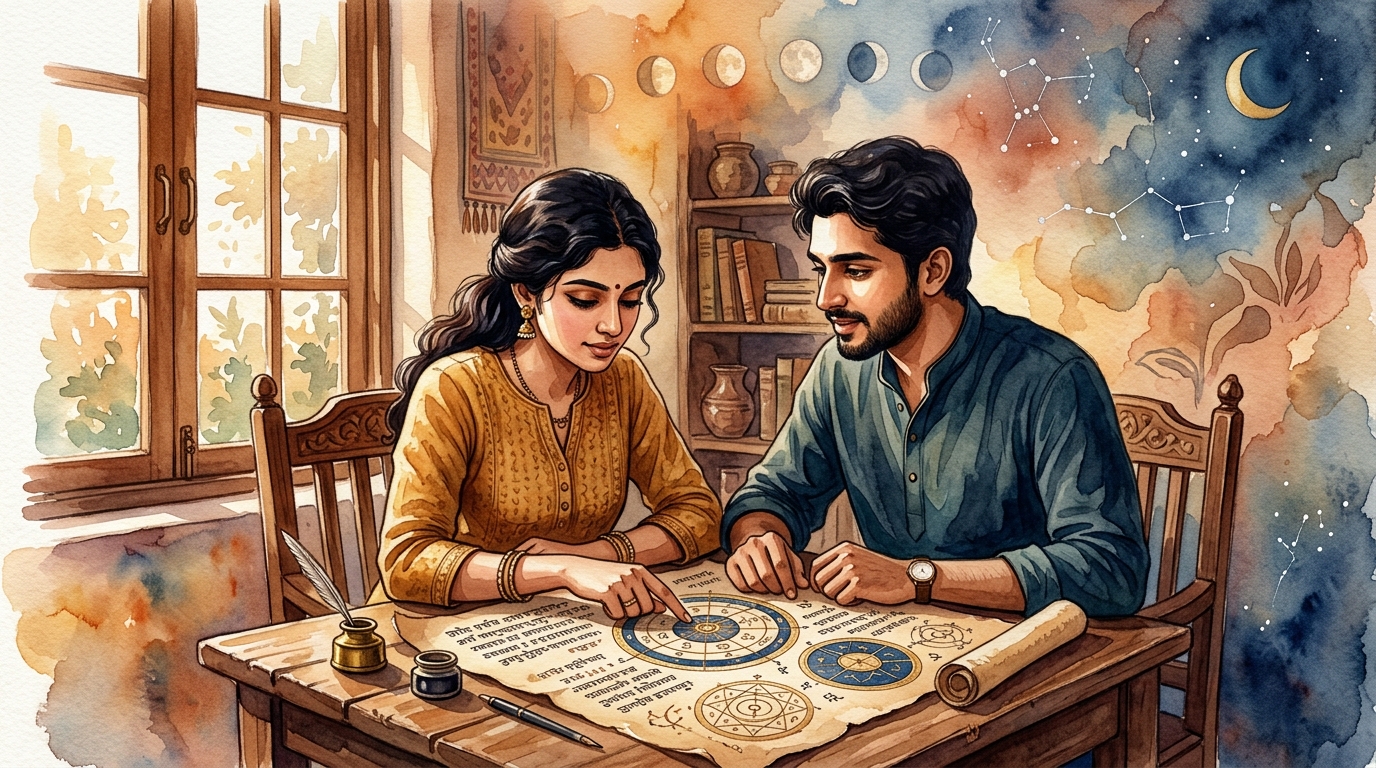
Picture this: you've met someone wonderful, the conversations flow easily, the families seem to approve — and then the astrologer sits down with both of your birth charts and announces a score of 21 out of 36. Is that good? Is that a warning? Should you be relieved or concerned?
If you've ever been through the Kundali matching process — or watched a family member go through it — you know that the number itself often creates more confusion than clarity. Most people walk away knowing their score but not understanding what it actually means. And that's a real problem, because the system behind that number is genuinely thoughtful and layered.
Here's the thing: Guna Milan isn't a compatibility quiz. It's an eight-category framework developed over centuries in Vedic astrology, designed to assess everything from physical intimacy to long-term health outcomes. Understanding each category changes everything about how you read your result.
What Is Kundali Matching and Why Does It Still Matter?
Kundali matching — also called horoscope matching or Guna Milan — is the traditional Vedic astrological method for assessing marriage compatibility. Unlike Western sun-sign comparisons, it works almost entirely from the Moon sign (Rashi) and Nakshatra (lunar mansion) of each person. The Moon, in Vedic thought, governs the mind, emotions, and instinctive reactions — so matching on this level is considered far more intimate than matching sun signs.
The system has been used across South Asia for centuries, and it remains remarkably common today. A 2023 survey by the Indian Marriage Foundation found that over 60% of arranged marriages in urban India still include some form of Kundali matching as part of the decision process. But it's not just traditional families — plenty of modern couples with love marriages use it as a second opinion, a sanity check, or simply out of curiosity.
The reason it endures isn't superstition. It's that the framework actually tries to answer specific, practical questions: Will these two people's temperaments clash constantly? Are there health risks to consider? Will one partner tend to dominate the other? These aren't abstract concerns.
For a broader picture of how this fits into the larger compatibility landscape — including why the same couple gets different answers from different systems — it's worth reading about how Vedic and Western astrology reach different compatibility conclusions.
The Ashtakoot System: 8 Categories That Build the 36-Point Score
The word 'Ashtakoot' literally means 'eight groups.' Each Koota (category) is assigned a maximum point value, and the total across all eight adds up to 36. The categories are not weighted equally — Nadi carries 8 points, while Varna carries just 1. That asymmetry is intentional and meaningful.
Let's go through each one carefully.
Varna: Soul Compatibility (1 Point)
Varna is the smallest category by point value, but it sets the tone for the entire match. It divides people into four spiritual archetypes — Brahmin (intellectual/spiritual), Kshatriya (warrior/leader), Vaishya (merchant/practical), and Shudra (service/labor) — based on their Moon sign, not their birth caste. The principle here is about ego compatibility: the partner with the higher Varna should be the man, or they should match. A mismatch doesn't tank the score significantly, but it suggests potential friction around status, respect, and self-image.
In practice, most astrologers treat a Varna mismatch as a minor concern, not a dealbreaker.
Vashya: Power Dynamics (2 Points)
Vashya examines the natural power balance between two people. Each Rashi is classified as one of five types: Manav (human), Vanchar (wild), Chatushpad (four-legged), Jalchar (water), and Keet (insect). The question being asked is: does one person naturally hold more sway over the other, and is that dynamic healthy?
Full points are awarded when both signs have mutual influence. Partial points when the influence flows one way. Zero when there's no natural affinity. This one speaks to long-term dynamics — who tends to make decisions, who tends to defer, and whether that balance feels mutual or uncomfortable.
Tara: Destiny Alignment (3 Points)
Tara is calculated by counting the Nakshatra positions of both partners relative to each other. There are 27 Nakshatras, and the count from one partner's birth Nakshatra to the other's determines the Tara classification. The resulting number falls into categories of auspicious or inauspicious destiny influence.
Think of Tara as the 'fortune compatibility' category — does this relationship tend to bring good luck and positive circumstances to both partners, or does it create friction in their individual paths? A poor Tara score doesn't mean disaster, but it can suggest that the couple will need to work harder against external circumstances.
Yoni: Physical and Intimate Compatibility (4 Points)
Yoni is one of the more direct categories in the system. Each Nakshatra is assigned an animal symbol — there are 14 animal pairs in total — and compatibility is scored based on whether the two animals are friendly, neutral, or hostile to each other. (Yes, this is exactly as literal as it sounds — the system uses animal symbolism to represent instinctive, physical energy.)
This Koota addresses physical chemistry, intimacy, and sexual compatibility. Astrologers generally consider a Yoni score of 2 or above acceptable, though 3-4 is ideal. A hostile Yoni pairing (like a snake and mongoose) isn't necessarily a dealbreaker but does suggest that physical friction may need conscious attention.
Graha Maitri: Mental Compatibility (5 Points)
This is the intellectual and emotional friendship category. Graha Maitri compares the ruling planets (lords) of each partner's Moon sign and assesses whether those planets are friends, neutrals, or enemies in Vedic planetary relationships.
A strong Graha Maitri score suggests the couple will naturally understand each other's thinking, share similar values, and feel mentally at ease together. A weak score here is one of the more practically significant mismatches — it can manifest as chronic misunderstanding, different world views, or the feeling that you're never quite on the same page. For couples who've already noticed communication struggles, this category (along with Mercury sign compatibility) deserves close attention.
Gana: Temperament Match (6 Points)
Gana divides all 27 Nakshatras into three temperament groups: Deva (divine/gentle), Manav (human/balanced), and Rakshasa (fierce/independent). The scoring is straightforward — same Gana gets full points, compatible combinations get partial points, and a Deva-Rakshasa pairing gets zero.
This is one of the more visible categories in daily life. Gana mismatch is often what people describe when they say 'we just have very different energies.' A Deva-natured person tends to be peace-seeking, harmonious, and spiritually inclined. A Rakshasa-natured person tends to be intense, direct, and unconventional. These aren't bad traits — but they require genuine mutual respect to work long-term.
Bhakoot: Emotional and Financial Prosperity (7 Points)
Bhakoot Dosha is one of the two most significant concerns in the entire system (the other being Nadi). It's calculated by comparing the Moon sign positions of both partners and checking for specific inauspicious combinations — particularly the 2-12, 5-9, and 6-8 Rashi relationships.
A Bhakoot Dosha is associated with financial difficulties, emotional distance, and in traditional texts, even health challenges for children. When Bhakoot Dosha is present, many astrologers will flag it regardless of the overall score. A couple scoring 28 out of 36 but carrying a Bhakoot Dosha may actually be considered more at-risk than a couple scoring 22 without it.
This is exactly why understanding individual categories matters more than fixating on the total.
Nadi: Health and Genetic Compatibility (8 Points)
Nadi carries the highest point value in the system, and it's treated with the most seriousness. Each Nakshatra belongs to one of three Nadis: Adi (first), Madhya (middle), or Antya (last). The rule is simple — partners should not share the same Nadi.
Nadi Dosha (same Nadi match) is considered the most severe concern in Guna Milan. Traditional Vedic astrology associates it with health problems, difficulties conceiving, or genetic incompatibilities. Modern interpretations sometimes frame it as energetic incompatibility — two people of the same Nadi may be 'too similar' at a fundamental biological level.
A Nadi Dosha can technically be cancelled (more on that below), but many astrologers treat it as a serious flag that warrants deeper investigation rather than dismissal.
What Score Is Actually Considered Acceptable for Marriage?
Here's where most people get confused. The thresholds are:
| Score Range | Traditional Interpretation |
|---|---|
| 0 – 17 | Not recommended; significant incompatibility |
| 18 – 24 | Acceptable; average compatibility |
| 25 – 32 | Good match; recommended |
| 33 – 36 | Excellent match; rare |
But — and this is the critical point — these ranges assume no major Doshas are present. A score of 28 with Nadi Dosha is not simply 'a good match.' And a score of 20 with strong Graha Maitri, clean Nadi, and no Bhakoot Dosha is often considered more favorable than the numbers suggest.
The 18-point minimum threshold exists because below that level, too many fundamental categories are mismatched. Above 18, the conversation shifts from 'is this viable' to 'what are the specific dynamics to be aware of.'
Dosha Exceptions: When a Low Score Can Be Overridden
Vedic astrology has always built in flexibility. There are established cancellation conditions (called 'Dosha Parihara') for both Nadi Dosha and Bhakoot Dosha.
Nadi Dosha cancellations can occur when:
- Both partners share the same Rashi but different Nakshatras
- Both partners share the same Nakshatra but different Rashis
- The Nakshatra lord is the same for both partners
Bhakoot Dosha cancellations occur when:
- The Rashi lords are mutual friends
- Both partners belong to the same Rashi
- The Navamsha (ninth divisional chart) shows strong compatibility
Beyond these technical cancellations, the broader chart matters enormously. Mangal Dosha — the Mars placement concern that's separate from Guna Milan entirely — can affect how a match is assessed even when the Guna score looks solid. A skilled astrologer examines multiple layers simultaneously, not just the 36-point tally.
What Kundali Matching Doesn't Tell You (And What to Use Instead)
Look, I want to be honest about the limits here. The Ashtakoot system is genuinely sophisticated for what it measures — Moon-based energetic compatibility, temperamental alignment, and certain health/destiny indicators. But there are real gaps.
The system doesn't assess:
- Communication style — how you handle conflict, whether you process emotions out loud or internally
- Life goals alignment — career ambitions, where you want to live, whether you want children
- Shared values — financial philosophy, religious practice, family priorities
- Growth compatibility — whether you'll evolve together or pull in different directions over time
For those dimensions, Western synastry tools and composite chart analysis offer complementary insight. Moon sign compatibility digs into emotional timing in ways that Guna Milan doesn't fully address. And if you're curious about the deeper karmic threads in a relationship, karmic relationship indicators in astrology add yet another layer.
The smartest approach is treating Kundali matching as one lens among several — authoritative within its domain, but not the whole picture. This is actually consistent with how traditional Vedic astrologers practiced: they used Guna Milan as a starting filter, then examined the full Kundali for planetary placements, Dasha periods, and chart overlays before making a final assessment.
For a deeper look at how Vedic compatibility analysis compares to Western methods — including why the sidereal zodiac produces different Nakshatra assignments — this comparison of sidereal vs. tropical zodiac compatibility is worth reading. And if you're working without a precise birth time, there are still meaningful ways to approach Vedic compatibility analysis without birth time.
How to Check Your Guna Milan Score Online
Calculating Guna Milan manually requires knowing both partners' exact Moon signs and Nakshatras, which in turn requires accurate birth times and locations. The calculation itself is formulaic once you have those inputs — each Koota has a defined lookup table.
Most online tools will give you the total score and a basic breakdown by category. The better ones will flag specific Doshas and note cancellation conditions. What most tools won't do is interpret the combination of your scores — which categories you're strong in, which you're weak in, and what that pattern means for your specific relationship.
That context is exactly what this article is trying to give you. When you check your Vedic compatibility score with our free calculator, you'll see not just a number but a breakdown that reflects the actual weight and meaning of each category.
A few practical tips for using any Guna Milan tool:
- Input birth time carefully — even a 30-minute difference can shift the Nakshatra assignment, which changes everything downstream
- Note which categories you scored zero on — a zero in Nadi or Bhakoot deserves more attention than a zero in Varna
- Look for Dosha flags separately — some tools calculate Doshas independently of the Guna score; make sure you're seeing both
- Don't compare scores across couples — a 24 for one couple is not the same as a 24 for another if the category breakdown differs significantly
The 36-point system has survived centuries because it genuinely captures something real about human compatibility — the way two people's instinctive natures, physical energies, and life trajectories interact. But it works best when you understand what's actually being measured, not just the final tally.
So if you're sitting with a score that confused you, or preparing for a match reading, or just curious about someone you've been seeing — now you have the framework to make sense of what you're looking at. Go beyond the number. That's where the real insight lives.