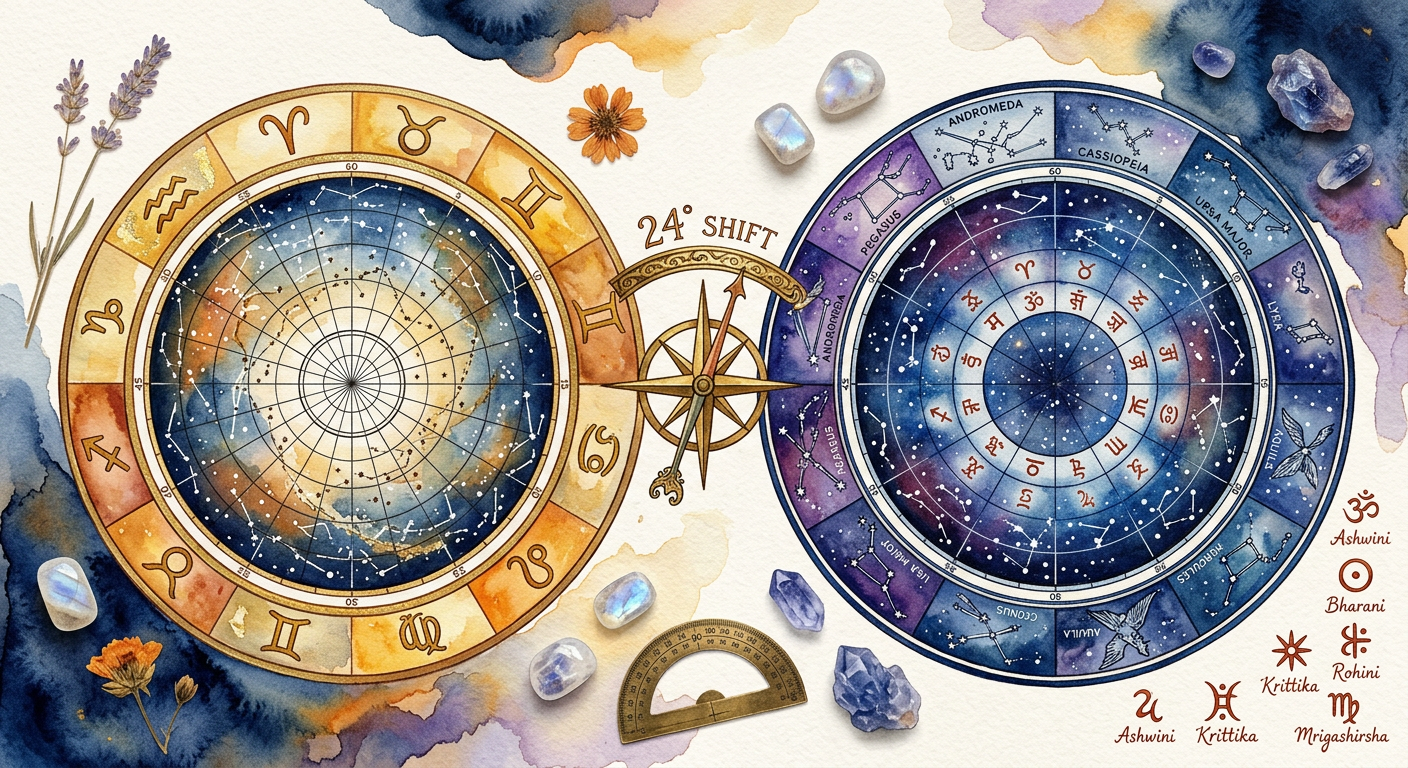
Most people don't realize their Sun sign might be different in Vedic astrology. That single fact — and the 23-degree shift behind it — explains why two people can run their charts through different tools and get completely opposite compatibility verdicts.
This isn't about one calculator being wrong. It's about two fundamentally different zodiac systems, each internally consistent, each producing real (and sometimes contradictory) insights. If you've ever wondered why the same couple gets different answers in Vedic vs. Western astrology, the sidereal/tropical divide is where the answer lives.
Here's what actually separates these systems, how they change your compatibility reading, and what to look for when choosing a sidereal compatibility calculator.
The Core Difference: Where the Two Zodiacs Actually Diverge
The tropical zodiac anchors Aries at the spring equinox — a fixed seasonal point. Every year, when the Sun crosses the vernal equinox (around March 20), tropical astrology calls that 0° Aries. This system is tied to Earth's seasons, not the stars.
The sidereal zodiac anchors Aries to the actual star constellations. Specifically, it aligns with fixed stars in the sky.
The problem? Earth wobbles. Due to a slow gravitational wobble called the precession of the equinoxes, the constellations appear to drift backward against the seasonal calendar at roughly 50 arc-seconds per year. Over centuries, this adds up. The two zodiacs have drifted approximately 23-24 degrees apart — a gap called the ayanamsa.
So when a Western astrologer says you're a Scorpio Sun, a Vedic astrologer using the sidereal zodiac might see you as a Libra Sun. Same birth data. Different framework. Different story.
How the Ayanamsa Creates a ~23-Degree Shift in Your Chart
The ayanamsa is the angular difference between the tropical and sidereal zodiacs at any given moment. It's not a fixed number — it changes slightly each year as the precession continues.
The most widely used version is the Lahiri Ayanamsa, officially adopted by the Indian government's Rashtriya Panchang in 1952. As of 2026, it sits at approximately 24°07'. Other ayanamsas exist — Raman, Krishnamurti, Fagan-Bradley — and each produces slightly different chart placements. But Lahiri is the standard in most Vedic compatibility tools.
Practically, this means: subtract roughly 23-24 degrees from your tropical position to get your sidereal position. A planet at 10° Scorpio in the tropical zodiac would land at roughly 16-17° Libra in the sidereal system.
What This Means for Your Sun Sign
About 80% of people born in the first two weeks of any tropical Sun sign will shift back one sign in the sidereal system. If you're a tropical Sagittarius born December 1, you're likely a Scorpio in Vedic astrology. This isn't an error — it's the system working exactly as designed.
For compatibility, this matters enormously. Sun sign compatibility tables are entirely different between systems. A tropical Sagittarius-Aries pairing (fire-fire, highly compatible in Western astrology) might become a Scorpio-Pisces pairing in Vedic — a water-water combination with different relational dynamics.
What This Means for Your Moon Sign and Rising Sign
Moon sign shifts are arguably more consequential for compatibility than Sun sign shifts — especially in Vedic astrology, where the Moon is the primary relationship indicator. Your Nakshatra (the lunar mansion your Moon occupies) changes with the sidereal Moon position, and Nakshatra compatibility — called Koota matching — is the backbone of Vedic relationship analysis.
Rising sign shifts affect your chart's entire house structure. In Western synastry, house overlays are critical: where your partner's planets fall in your houses indicates relationship themes. A sidereal rising can shift every house cusp, reorganizing those overlays completely.
(If you're wondering how much your Rising sign matters in compatibility, the evidence for rising sign compatibility is actually stronger than most Sun-sign-based comparisons.)
How Compatibility Analysis Changes Between Sidereal and Tropical
Synastry in Tropical: Aspect-Based Interpretation
Western tropical astrology analyzes compatibility through synastry — overlaying two birth charts and examining the geometric angles (aspects) between planets. A Venus-Mars trine between partners signals attraction. Saturn conjunct the Moon suggests emotional restriction. The Sun in one person's 7th house indicates partnership potential.
This system is flexible, nuanced, and psychological in orientation. It draws heavily on modern psychological frameworks. The aspects are mathematical — 60°, 90°, 120°, 180° — and the orbs (how close the angle has to be) vary by practitioner.
Tropical synastry is particularly strong at describing relationship dynamics: communication patterns, attraction chemistry, power struggles, and growth areas. But it doesn't predict outcomes as directly as Vedic systems attempt to.
Kundali Matching in Sidereal: Nakshatra-Based Interpretation
Vedic sidereal compatibility uses Kundali matching (also called Guna Milan or Ashtakoota), a structured 36-point system based almost entirely on the Moon's Nakshatra in both charts. Each of 27 Nakshatras belongs to a specific sign, and their interactions are scored across eight categories covering temperament, sexual compatibility, biological compatibility, and spiritual alignment.
A score of 18+ is considered acceptable. 24+ is good. 28+ is excellent. Below 18 traditionally raises concerns, though contemporary Vedic astrologers weigh other chart factors alongside the score.
This system is more prescriptive — it generates a number. That feels reassuring to many users, but it can also flatten nuance. Two people with a low Guna score might have exceptional Navamsa chart compatibility or strong Dasha timing that overrides the baseline score.
For a deeper look at how Vedic compatibility calculators handle this scoring differently, the variance between tools is significant.
Comparing the Two Systems
| Strategy | Best For | Pros | Cons | ROI for Compatibility Use |
|---|---|---|---|---|
| Tropical Synastry | Psychological insight, relationship dynamics | Nuanced, aspect-rich, strong psychological framework | No predictive scoring, interpretation-dependent | High for understanding how a relationship functions |
| Sidereal Kundali Matching | Long-term compatibility prediction, marriage timing | Structured scoring, Nakshatra precision, predictive | Can feel rigid, less psychological depth | High for assessing whether a relationship is sustainable |
| Sidereal Synastry | Combining Vedic placements with aspect analysis | Nakshatra-accurate positions with Western-style aspects | Less standardized, fewer tools support it | Moderate — growing methodology |
| Combined Sidereal + Tropical | Full-spectrum compatibility reading | Covers both seasonal/psychological and stellar/karmic layers | Requires fluency in both systems | Highest — most complete picture |
| Sun-Sign Matching (either system) | Quick, casual assessment | Fast, accessible, widely understood | Misses 90% of chart complexity | Low — sun sign compatibility is only about 10% of the picture |
Real Example: The Same Couple Analyzed in Both Systems
Let me make this concrete. Take a hypothetical couple: Person A born November 28, and Person B born March 15.
In the tropical zodiac:
- Person A: Sun in Sagittarius, Moon in Gemini (hypothetical)
- Person B: Sun in Pisces, Moon in Scorpio (hypothetical)
Tropical synastry reads this as a Sagittarius-Pisces pairing. Both are mutable signs — adaptable, restless, prone to avoidance. The Gemini Moon opposite Sagittarius Sun creates a push-pull dynamic. The Scorpio Moon trine Pisces Sun suggests deep emotional resonance. Overall Western reading: intellectually stimulating, emotionally intense, but commitment may be elusive.
In the sidereal zodiac (subtract ~24°):
- Person A: Sun shifts to Scorpio, Moon shifts to Taurus
- Person B: Sun shifts to Aquarius, Moon shifts to Libra
Now the Kundali analysis checks Moon Nakshatras. Taurus Moon likely falls in Rohini Nakshatra; Libra Moon likely falls in Swati Nakshatra. Rohini and Swati have a specific Koota relationship — their Guna score across the eight categories would generate a concrete compatibility number.
The narrative changes entirely. Instead of a mutable-sign psychological profile, Vedic analysis sees a Scorpio-Aquarius pairing (fixed signs, strong-willed, potentially inflexible) with Taurus-Libra Moons (both Venus-ruled, aesthetically aligned, harmony-seeking). The compatibility story shifts from 'will they commit?' to 'can they handle each other's stubbornness?'
Same couple. Different questions. Both legitimate.
This is exactly why using a calculator that runs both sidereal and tropical systems side by side gives you information no single-system tool can.
Which System Is More Accurate for Compatibility Prediction?
Honest answer: neither is universally more accurate. The research on astrological prediction accuracy is mixed at best, and both systems have devoted practitioners producing detailed, often insightful readings.
What they're measuring differs:
- Tropical astrology is measuring your relationship to the Sun's seasonal cycle — a psychological and archetypal orientation.
- Sidereal astrology is measuring your relationship to the actual star positions at birth — a more literal stellar alignment.
I think the more useful question is: what are you trying to learn? If you want to understand communication dynamics and emotional patterns, tropical synastry with strong attention to Mercury placements and Moon signs gives you rich material. If you want a structural assessment of long-term compatibility with predictive elements, Vedic sidereal Kundali matching is built for that purpose.
But here's the thing: the practitioners who work in both traditions consistently report that the most complete compatibility readings use both systems as lenses, not competitors.
For a related perspective on Vedic compatibility when birth time is uncertain — which affects both sidereal rising signs and Nakshatra precision — the approach to Vedic astrology compatibility without birth time covers the workarounds.
How to Choose the Right System for Your Needs
Choose tropical synastry if:
- You're focused on understanding relationship dynamics, not prediction
- You or your partner are unfamiliar with Vedic astrology and want accessible insights
- You want to analyze specific planets beyond the Moon (Venus-Mars aspects, Saturn overlays)
- You're exploring karmic relationship patterns through South Node and Chiron contacts
Choose sidereal Kundali matching if:
- You're evaluating long-term partnership or marriage potential
- You want a structured, scored assessment rather than open-ended interpretation
- You or your partner have Indian cultural or family context where Kundali matching carries significance
- You want Nakshatra-level precision on Moon compatibility
Use both if:
- You want the most complete picture available
- You're comfortable holding two frameworks simultaneously
- You're comparing a serious long-term relationship, not a casual assessment
And look — neither system is a verdict. Even a perfect Guna score doesn't guarantee relationship success. Even a challenging synastry doesn't doom a couple. These are tools for reflection, not deterministic forecasts.
Sidereal Compatibility Calculators: What to Look for in a Tool
Not all sidereal compatibility calculators are built the same. Here's what separates useful tools from shallow ones.
Ayanamsa transparency. The tool should specify which ayanamsa it uses. Lahiri is standard for Vedic work. If a calculator doesn't disclose this, you can't trust the chart positions it generates. The difference between Lahiri and Raman ayanamsa is roughly half a degree — small, but enough to shift a borderline Nakshatra placement.
Nakshatra breakdown, not just sign matching. A serious sidereal compatibility tool shows you both partners' Moon Nakshatras and calculates Koota scores across all eight categories — not just a final number. Understanding why a score is high or low is more valuable than the number itself.
Birth time handling. Rising sign and precise Moon Nakshatra require accurate birth time. A good calculator either requests birth time explicitly or tells you clearly what accuracy limitations apply when it's unavailable. Tools that silently calculate rising signs from date-only data are producing unreliable outputs.
Both system outputs. The most useful sidereal compatibility calculators also show you the tropical equivalents. This lets you see both readings in one place and make informed comparisons — rather than getting one system's verdict and wondering what the other would say.
Explanation, not just scores. Compatibility numbers without context are nearly meaningless. A 28/36 Guna score with no explanation of which Kootas scored high and why tells you almost nothing actionable. Look for tools that break down what each component means.
So, if you're ready to see both systems applied to your actual chart, run your compatibility report in both sidereal and tropical systems and compare the outputs directly.
The Bottom Line
The sidereal/tropical split isn't a bug in astrology — it's a feature of two different philosophical traditions asking different questions about human relationships. Tropical asks: how does this person relate to the seasons, cycles, and archetypes of human experience? Sidereal asks: where were the planets actually positioned in the sky when this person was born?
Both questions are worth asking. The mistake is treating one system's answer as the only answer.
When you get a compatibility score that surprises you — either better or worse than expected — the first thing to check is which zodiac system generated it. A score built on tropical placements and a score built on sidereal placements are measuring genuinely different things. Neither is wrong. They're just not the same conversation.
Understanding the ayanamsa, knowing your Nakshatra, and being able to read both synastry and Kundali outputs puts you miles ahead of someone who's only ever seen their Sun sign compatibility table. Start there.