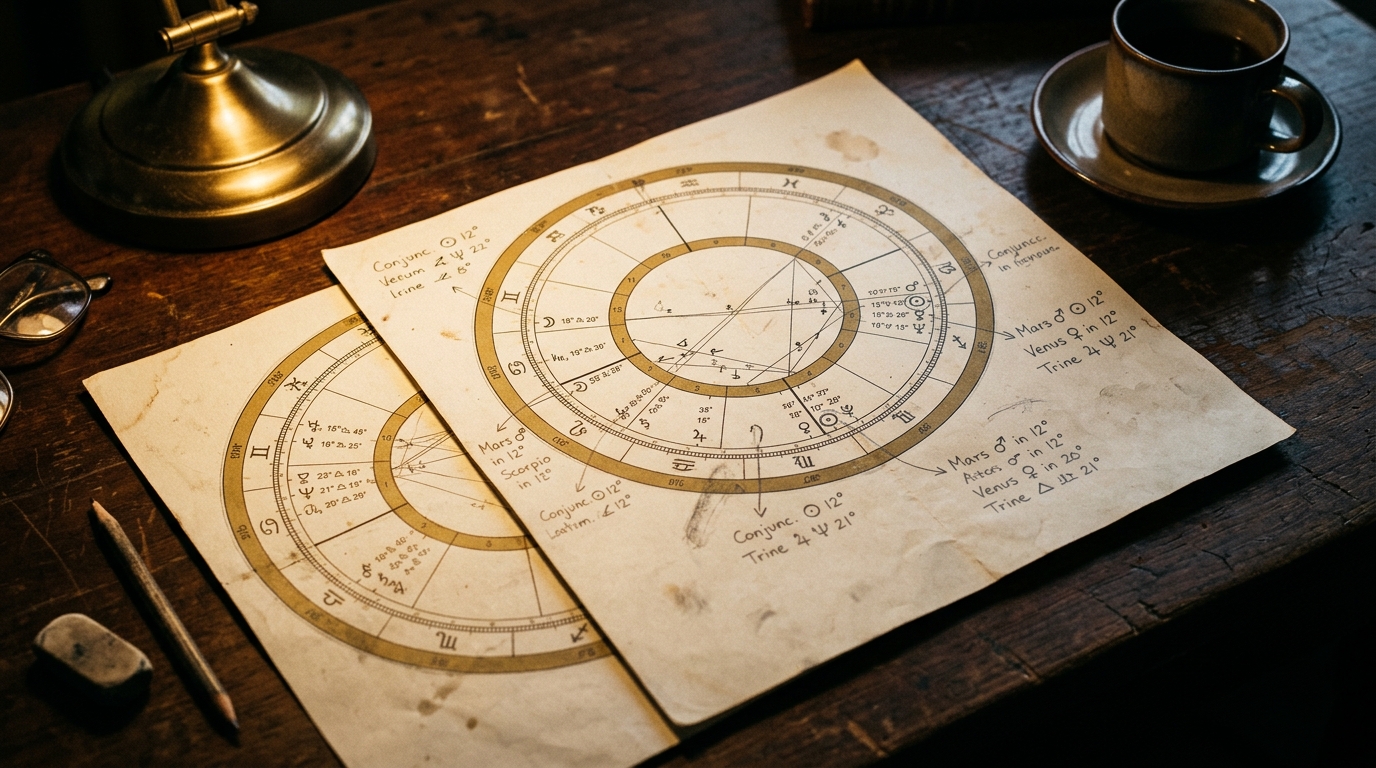
Most people who generate a synastry chart for the first time stare at it for about thirty seconds before closing the tab. Two wheels overlapping, lines crisscrossing in every direction, abbreviations that look like a chemistry exam. The chart isn't broken — you just haven't been given a reading order.
That's the actual problem. Every beginner guide to synastry tries to explain everything at once, which is the same as explaining nothing. This one doesn't do that. Instead, it gives you a sequence: start here, then move here, then here. And it's honest about where that sequence ends and where a trained eye becomes worth more than another hour of solo research.
What a Synastry Chart Actually Shows You
A synastry chart overlays two individual birth charts on top of each other to reveal how one person's planetary placements interact with another's. It's not a compatibility score. It's a map of contact points — places where your energy and someone else's energy meet, clash, amplify, or complicate each other.
The lines you see drawn across the chart represent aspects — angular relationships between planets. A line connecting your Venus to their Mars means those two planets are in conversation. Whether that conversation is easy or difficult depends on the angle between them.
What synastry doesn't show you is the whole picture in a single glance. That's the trap beginners fall into — trying to read everything simultaneously. What synastry is actually measuring across all these layers is a layered system, and reading it well means reading it in order.
Step 1: Find the Personal Planets First (Sun, Moon, Venus, Mars, Mercury)
Before you look at anything else, locate these five planets in both charts: Sun, Moon, Venus, Mars, and Mercury. Ignore everything else for now. Literally ignore it.
Why These Five Matter More Than Anything Else in a First Reading
The personal planets represent the parts of a person that are most immediately present in a relationship. The Sun is identity and ego. The Moon is emotional wiring and instinctive needs. Venus governs attraction, affection, and what you find beautiful or valuable. Mars is drive, desire, and how you pursue things (including people). Mercury shapes how you think and communicate.
When two people's personal planets interact strongly, you feel it. When they don't, you also feel it — as a kind of flatness or disconnect that's hard to name.
The outer planets (Saturn, Jupiter, Uranus, Neptune, Pluto) matter enormously, but they move slowly enough that they affect entire generations. If your Neptune conjuncts someone's Neptune, that's because you're roughly the same age — it tells you almost nothing about your specific dynamic. Save those for later.
Mark up your chart: circle or highlight every personal planet contact you can find between the two charts. That's your working material.
Step 2: Look for Conjunctions and Oppositions Before Anything Else
Now that you've identified the personal planet contacts, sort them by aspect type. Start with the two most powerful: conjunctions (0°) and oppositions (180°).
Trines and sextiles are real, and they matter. But conjunctions and oppositions generate the most noticeable energy in a relationship — the moments of intense recognition or friction that define how two people experience each other. Trines tend to operate quietly in the background, which makes them easy to underestimate and easy to miss in a first reading.
What a Conjunction Between Two People's Planets Means
A conjunction means two planets occupy roughly the same degree in the zodiac. In synastry, it means one person's planetary energy lands directly on the other person's. Your Venus conjunct their Sun: your affection and aesthetic sensibility hit directly at their core identity. It creates a powerful sense of recognition — often that "I feel seen" quality that characterizes early attraction.
Conjunctions aren't automatically positive. Your Mars conjunct their Mars can produce either exceptional drive toward shared goals or a constant low-grade competition. Context matters. The planets involved, the signs they're in, and what else is happening in the chart all shape the outcome.
Oppositions: Magnetic Tension That Can Go Either Way
Oppositions (planets sitting 180° apart across the chart) create a push-pull dynamic. Your Moon opposite their Sun is one of the most common aspects in long-term relationships — and also one of the most discussed, because it produces both deep attraction and recurring friction.
The tension of an opposition isn't a flaw. It's more like a conversation that never fully resolves, which keeps two people engaged with each other over time. Many stable couples have prominent oppositions in synastry. The question is whether the tension is generative or exhausting — and that depends heavily on both people's individual charts and emotional maturity, not just the aspect itself.
Step 3: Check the Ascendant Overlays
Once you've worked through the personal planet conjunctions and oppositions, look at the Ascendant — the rising sign — for both people.
What It Means When Someone's Planet Falls on Your Rising Sign
The Ascendant represents how you present yourself to the world, your physical appearance and first impression, and the lens through which you experience your immediate environment. Rising sign / Ascendant compatibility is often underestimated in beginner readings because it doesn't show up as a planet — it's a point.
When someone's personal planet — especially their Sun, Venus, or Mars — falls conjunct your Ascendant, they see you very clearly. Their perception of you aligns with how you actually project yourself. This creates a feeling of being genuinely recognized rather than misread. It's also why some people feel immediately comfortable with a stranger while others feel oddly invisible or misunderstood despite a perfectly pleasant interaction.
Your rising sign compatibility also affects physical chemistry in ways that Sun sign comparisons simply can't capture. Your rising sign compatibility matters more than your Sun sign in predicting that immediate, instinctive pull — or its absence.
Check both directions: what falls on your Ascendant, and what falls on theirs.
Step 4: Find Mercury Contacts for Communication Compatibility
Relationships don't just run on attraction. They run on conversation, on the ability to understand and be understood, on whether two people can actually talk to each other without constant misinterpretation. Mercury contacts in synastry are where that plays out.
Communication compatibility (Mercury sign) is one of the most practically significant areas of a synastry chart — and one of the most overlooked in surface-level readings that focus almost entirely on Venus and Mars.
Mercury Trine vs. Mercury Square: The Difference in Practice
A Mercury trine between two charts means the two people's mental styles flow naturally together. They tend to finish each other's sentences, find the same things interesting, and rarely feel like they're talking past each other. It doesn't mean they always agree — it means the style of thinking is compatible.
A Mercury square is different. It creates friction in how information is processed and exchanged. One person thinks in linear steps; the other jumps between associations. One person values precision; the other values emotional resonance. Neither approach is wrong, but they can create exhausting misunderstandings over time — the kind where both people feel like they explained themselves clearly and were still misunderstood.
The research behind why couples who look compatible on paper keep fighting almost always traces back to Mercury incompatibility. It's the sleeper issue in synastry.
A Mercury square doesn't doom a relationship. But it does mean both people need to consciously adjust their communication style — and knowing it's there is half the battle.
Step 5: Look at the Outer Planet Contacts Last
Now you can look at Saturn, Uranus, Neptune, and Pluto. Not before.
Saturn, Uranus, Neptune, Pluto in Synastry — What They Mean and What They Don't
Saturn contacts in synastry are the most discussed outer planet aspects, and for good reason. When Saturn makes a hard aspect to someone's personal planet — especially their Moon or Venus — it introduces a quality of seriousness, restriction, or obligation into that area of the relationship. Saturn conjunct Moon can feel like emotional heaviness or a sense of duty. It can also create profound stability and commitment. Saturn, North Node, and Juno: the three placements that predict whether a relationship lasts goes deep on this — Saturn's role in long-term compatibility is real, but it's not simple.
Uranus contacts bring unpredictability and excitement. They're common in relationships that feel electric but struggle to stabilize. Neptune contacts can produce idealization — one person projects qualities onto the other that may not actually be there. Pluto contacts are transformative, sometimes uncomfortably so; they tend to mark relationships that fundamentally change both people.
Here's the honest thing about outer planet contacts: they're genuinely difficult to interpret without context. A Neptune square Venus could mean beautiful, spiritually-tinged romance. It could also mean one person is running a sustained unconscious fantasy about the other. You need the whole chart to tell the difference.
Where Self-Interpretation Breaks Down
You've now worked through five steps. You have a much clearer picture than you did thirty minutes ago. You've also, almost certainly, found aspects that seem to contradict each other — and that's where most self-readings stall.
The Problem With Reading Aspects in Isolation
Every aspect in a synastry chart exists in relationship to every other aspect. A Venus-Mars opposition that looks challenging on its own might be softened by a Moon trine Moon that creates deep emotional attunement. A Saturn square Sun that looks heavy might be balanced by Jupiter contacts that bring optimism and expansion.
This is not a caveat — it's the actual structure of how synastry works. The chart is a system, not a list. Reading aspects one at a time and adding up positives vs. negatives is like trying to understand a conversation by reading individual words without sentences.
Beginners who try to synthesize everything themselves often end up more confused than when they started, or — more dangerously — they fixate on one dramatic aspect and let it color their interpretation of everything else. A single Pluto conjunction doesn't make a relationship karmic and fated. A single Saturn square doesn't make it doomed. How to tell if you're meant to be together or meant to learn a lesson requires looking at the full picture, not one dramatic line on the chart.
What a Specialist Sees That You Can't See Alone
A trained synastry reader doesn't just know more aspects — they know how aspects talk to each other. They can tell you whether the tension you're feeling in communication has a root in Mercury contacts, or whether it's actually a Moon-Saturn dynamic expressing itself through conversation. They can identify which difficult aspects are growth edges and which are genuine incompatibilities that won't resolve with effort.
They also bring something no chart interpretation guide can: the ability to ask questions. A chart doesn't tell you which relationship you're asking about. It doesn't know whether you're in the early stages of dating or ten years in. Context shapes interpretation enormously.
There's a point in every synastry reading where the chart stops being self-explanatory and starts requiring judgment. That's not a failure of the chart or of you — it's just the nature of the tool. Comparing composite chart vs. synastry shows how even experienced readers use multiple frameworks together to build a complete picture.
If you've worked through these five steps and you're still sitting with more questions than answers — or if you've found something that feels significant and you're not sure what to do with it — that's the natural moment to bring in a second perspective.
Have a specialist walk through your synastry chart with you — free and get a reading that treats the chart as a system, not a checklist.
The goal here was never to make you an expert in one article. It was to give you a map with a starting point marked. Most synastry guides fail beginners by presenting everything as equally important, which means nothing gets the attention it deserves. Start with the personal planets. Move to the major aspects. Check the Ascendant. Look at Mercury. Then — and only then — open the door to the outer planets.
And when the chart starts asking more of you than a reading guide can answer, that's not a dead end. That's just where the real conversation begins.