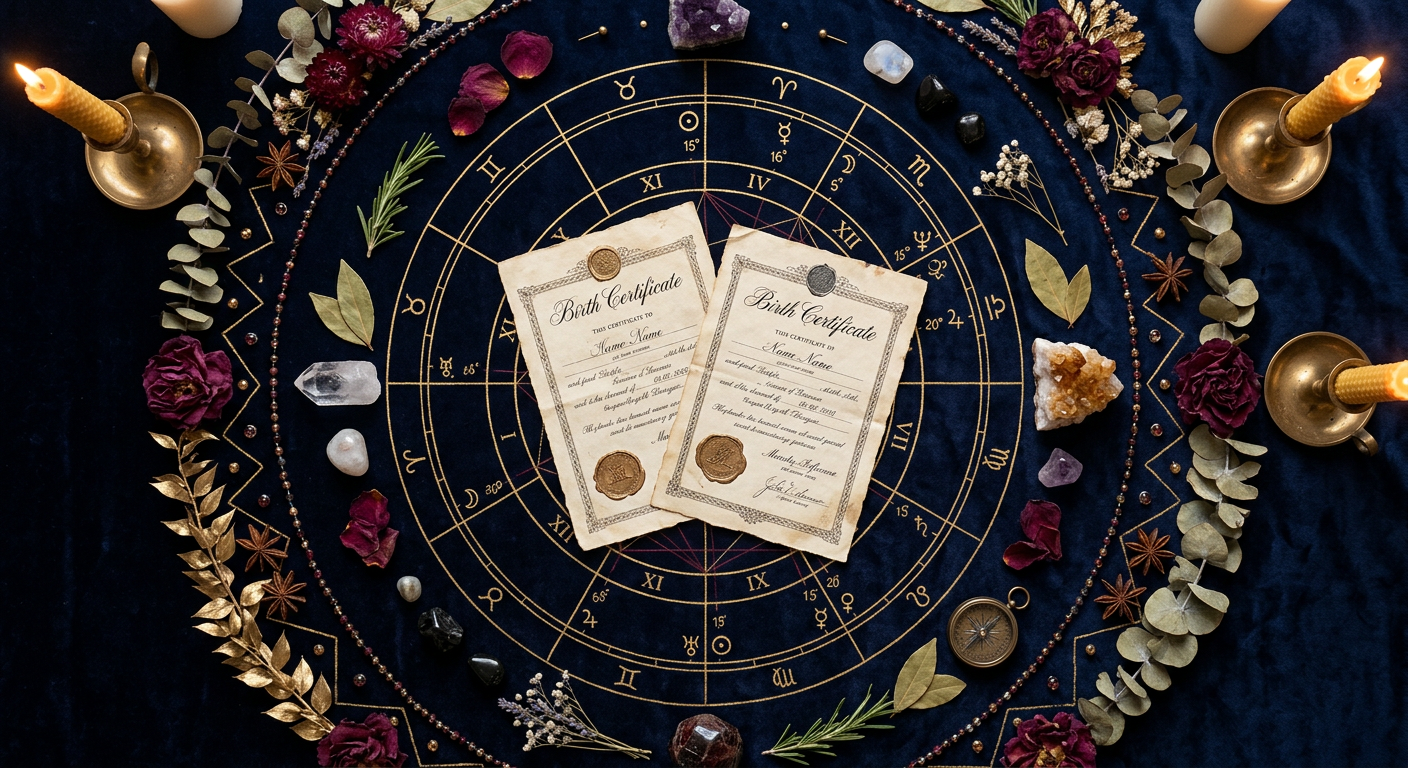
What Your Birth Date Really Reveals About Love Compatibility
You meet someone. The chemistry is real. So you do what millions of people do — you look up your signs.
But here's the thing: typing in two Sun signs and getting a percentage back isn't astrology. It's a rough sketch. Your actual birth date contains far more information than your Sun sign, and most people have no idea what's sitting in that data.
This isn't about dismissing Sun sign compatibility. It's about understanding exactly what your birth date unlocks — and where the limits are. Because once you know which planetary layers are calculable from your date alone versus what requires birth time, you'll use every compatibility tool smarter.
Why Your Full Birth Date Matters More Than Your Sun Sign
Sun signs get all the attention. Partly because they're easy — you only need the month and day. Partly because astrology columns have trained us to think in terms of Scorpio vs. Gemini, Aries vs. Libra.
But as explained in why sun sign is only part of your compatibility story, the Sun sign represents maybe 10% of a full astrological compatibility assessment. The remaining 90% comes from other planetary placements — and most of those are calculable from your full birth date (day, month, and year).
Here's what the year adds: it pins down the slower-moving planets. Mercury, Venus, and Mars all move through the zodiac at different speeds. Without the year, you can't know where Venus was when someone was born. With it, you can.
So the difference between 'my sign is Taurus' and 'I was born on May 3rd, 1990' is enormous in astrological terms.
The Three Core Data Points: Date, Time, and Place
Every complete natal chart requires three inputs:
- Date of birth — unlocks Sun, Mercury, Venus, Mars, Jupiter, Saturn, and outer planet positions
- Time of birth — adds the Ascendant (Rising sign), Midheaven, and precise house placements
- Place of birth — refines the Ascendant calculation and adjusts for local time zones
Date alone gets you surprisingly far. Time and place take you the rest of the way.
The critical insight: most planets don't move fast enough to require birth time for accurate placement. Venus, for example, spends roughly 4-6 weeks in each sign. Mars spends about 6-8 weeks. If you know someone was born on a specific date, you know their Venus sign — unless they were born on the exact day Venus changed signs.
Moon signs are the exception. The Moon moves through a sign every 2.5 days. Born near a sign boundary? You need the birth time to be certain.
What Astrologers Actually Extract From a Birth Date
Sun Sign: The Starting Point, Not the Whole Story
The Sun spends approximately 30 days in each zodiac sign. Your Sun sign describes your core identity, ego structure, and life direction. In compatibility terms, it shows how two people's fundamental natures interact.
But Sun sign compatibility is a starting point, not a verdict. Two Capricorns can have wildly different emotional needs, attraction patterns, and communication styles — because those are governed by other planets entirely.
That said, don't dismiss it. The Sun's position creates real energetic dynamics between two people. Fire signs (Aries, Leo, Sagittarius) bring enthusiasm and directness. Earth signs (Taurus, Virgo, Capricorn) bring stability and practicality. The elemental interaction matters.
Moon Sign and Emotional Wiring
This is where date-of-birth compatibility gets genuinely useful — and where most 'enter your sign' tools fall short.
The Moon governs emotional needs, instinctive reactions, and what makes you feel safe in a relationship. Moon sign compatibility often predicts whether two people feel emotionally at home together, separate from whether they're attracted to each other.
From a full birth date, astrologers can calculate the Moon sign for most people with high accuracy. The Moon changes signs every ~2.5 days, so the year, month, and day narrows it down considerably. (The caveat: if you were born within 12 hours of a Moon sign change, birth time becomes necessary for certainty.)
For compatibility purposes, Moon sign interactions are frequently more predictive of long-term emotional harmony than Sun sign pairings. A couple with clashing Sun signs but harmonious Moon signs often builds a surprisingly stable emotional foundation. Check out moon sign compatibility and emotional connection for a deeper breakdown of how this plays out.
Venus and Mars: The Relationship Planets
If Moon signs explain emotional compatibility, Venus and Mars explain romantic and physical compatibility.
Venus rules attraction style, what you find beautiful, how you express affection, and what you need to feel loved. Venus in Aries loves direct pursuit. Venus in Libra wants partnership and romance. Venus in Scorpio needs depth and intensity.
Mars rules desire, drive, sexual energy, and how you pursue what you want. Mars in Gemini flirts through conversation. Mars in Taurus is slow-burning and physical. Mars in Sagittarius wants adventure.
Both Venus and Mars are fully calculable from birth date alone (with rare exceptions at sign-change days). This means a good compatibility tool using just your birth dates can map out four distinct compatibility axes: Sun-Sun, Moon-Moon, Venus-Venus, and Mars-Mars — plus cross-planet interactions like Venus-Mars synastry, which is often the single strongest indicator of romantic chemistry.
For a closer look at how Venus and Mars interact between two charts, venus and mars compatibility in attraction astrology breaks this down specifically.
How Birth Date Compatibility Calculations Work
Planetary Positions on the Day You Were Born
Astrology uses precise astronomical data. The zodiac is a 360-degree band around the Earth, divided into 12 signs of 30 degrees each. Every planet occupies a specific degree within a sign at any given moment.
An ephemeris — essentially a table of planetary positions — records where every planet was on every day going back thousands of years. When you enter your birth date into a compatibility calculator, it's cross-referencing this data to determine your planetary positions.
For the Sun: straightforward. It moves roughly 1 degree per day, so date alone is sufficient. For Venus and Mars: moves fast enough that year + month + day gives accurate placement in almost all cases. For the Moon: date alone usually works, but a 12-hour window of uncertainty exists near sign changes. For Jupiter and Saturn: these move slowly enough that the year alone often suffices — month and day just add precision.
Aspect Patterns Between Two Charts
Once two people's planetary positions are calculated, compatibility analysis looks at aspects — the angular relationships between planets across the two charts.
This is called synastry. (If you want to understand how to actually read these charts, how to read a synastry chart without getting lost in the jargon is worth bookmarking.)
Key aspects in synastry:
| Aspect | Angle | Effect in Compatibility |
|---|---|---|
| Conjunction | 0° | Intensification — planets merge energy, can be harmonious or overwhelming |
| Trine | 120° | Natural flow, ease, compatibility |
| Sextile | 60° | Opportunity, friendly interaction |
| Square | 90° | Tension, friction, growth through challenge |
| Opposition | 180° | Polarity — attraction and conflict, often simultaneously |
A well-aspected Venus-Mars connection between two charts (especially conjunction or trine) is a strong indicator of romantic chemistry. Moon-Moon trines suggest emotional ease. Saturn aspects introduce themes of commitment and longevity — relevant if you're looking at saturn, north node, and juno in synastry for long-term compatibility.
All of these calculations are possible from birth date alone — no time required.
The Limits of Date-Only Compatibility Readings
Here's where I want to be completely straight with you, because most astrology tools aren't.
A birth date gives you a lot. But it has real gaps.
Before vs. After Adding Birth Time:
| Compatibility Factor | Date Only | Date + Time + Place |
|---|---|---|
| Sun sign | ✓ Accurate | ✓ Accurate |
| Venus sign | ✓ Accurate (99% of cases) | ✓ Accurate |
| Mars sign | ✓ Accurate (99% of cases) | ✓ Accurate |
| Moon sign | ✓ Usually accurate | ✓ Always accurate |
| Moon degree | ✗ Approximate | ✓ Precise |
| Ascendant / Rising sign | ✗ Not calculable | ✓ Accurate |
| House overlays | ✗ Not available | ✓ Full picture |
| Exact aspect degrees | ⚠ Approximate | ✓ Precise |
What Birth Time Adds to the Picture
The Ascendant (Rising sign) changes every ~2 hours. It's completely uncalculable without birth time. And the Ascendant matters — it shapes first impressions, physical presence, and how you show up in relationships before anyone sees your inner world.
In my experience, the couples where one person's Sun or Venus conjuncts the other's Ascendant have an almost magnetic initial pull. You can't see this without birth times.
House overlays are equally significant. Where your Venus falls in your partner's chart — which house it lands in — colors the entire relationship dynamic. Does your Venus activate their 7th house (partnership) or their 12th house (hidden, karmic)? That distinction is meaningful. But it requires birth time to calculate.
So a date-only reading gives you the planetary signs. A full birth data reading gives you the planetary signs, degrees, houses, and angles. That's the difference between knowing the instruments in an orchestra versus hearing the actual performance.
And look, if you don't have your birth time, that's okay. The date-only reading is still genuinely useful. It just means some layers remain invisible until you dig up that birth certificate.
How to Get the Most Accurate Compatibility Reading From Your Birth Data
Practical steps, in order of impact:
1. Gather the full birth date for both people. Year matters. Month and day without year means no Venus or Mars placement. Don't skip this.
2. Find birth times if possible. Birth certificates typically list time of birth. Hospital records are another source. Some people know from family memory. Even an approximate time (morning, evening) helps narrow the Ascendant to a few possibilities.
3. Use a tool that calculates multiple planets, not just Sun signs. If a tool only asks for your signs and not your dates, it's giving you a Sun-sign reading dressed up as full compatibility. Try our free astrology compatibility calculator by date of birth — it uses full birth date data to calculate Sun, Moon, Venus, and Mars placements for both people.
4. Look at cross-planet aspects, not just same-planet comparisons. Your Venus interacting with their Mars is often more revealing than comparing your Venuses to each other. Pay attention to the connections across planets.
5. Prioritize Moon and Venus aspects for emotional and romantic compatibility. Sun sign synastry sets the tone. Moon synastry predicts emotional safety. Venus-Mars synastry predicts attraction and desire. If you only have bandwidth to focus on three things, those are the three.
6. Treat squares and oppositions as information, not verdicts. Tension aspects don't mean incompatibility. They often mean growth, passion, and the kind of friction that keeps a relationship alive. Some of the most enduring couples in astrology compatibility celebrity couple charts have significant tension aspects.
7. Know what your tool can and can't tell you. A good tool is transparent about its limits. If it's date-only, it should acknowledge the Moon uncertainty and the absence of Ascendant data. Overconfident tools are the ones to be skeptical of.
Frequently Asked Questions
Can I get an accurate compatibility reading with just birth dates and no birth times? Yes — with caveats. You'll get accurate Sun, Venus, and Mars placements, and usually an accurate Moon sign. What you'll miss is the Ascendant, house overlays, and precise Moon degree. It's a solid reading, not a complete one.
What if I don't know my birth time? Start with what you have. A date-of-birth reading covers the major romantic planets. If you want to go deeper, many astrologers offer 'chart rectification' — a process of estimating birth time based on life events. It's not perfect, but it narrows things down.
Are birth date compatibility tools accurate? The accuracy depends on what they're calculating. Tools that only use Sun signs are giving you 10% of the picture. Tools that calculate Moon, Venus, and Mars from full birth dates are giving you a genuinely useful multi-layer reading. The methodology matters more than the interface.
Does birth year really change compatibility results? Significantly. Venus and Mars spend weeks to months in each sign. Two people born in the same month but different years can have completely different Venus placements — which changes the entire romantic dynamic.
What's the most important planet for love compatibility? It depends on what kind of compatibility you're assessing. Venus-Mars synastry tends to show romantic and physical chemistry most clearly. Moon-Moon aspects predict emotional compatibility and long-term comfort. Sun aspects show identity alignment. In my view, Moon synastry is the most underrated — it's often the difference between a relationship that feels like home versus one that always feels slightly off.
Is there a difference between Western and Vedic astrology compatibility calculations? Yes — the two systems use different zodiac frameworks and weight planets differently. Western astrology uses the tropical zodiac; Vedic uses the sidereal zodiac. This means the same birth date produces different sign placements in each system. Both are internally consistent — they just operate from different frameworks.
Your birth date is a more powerful data point than most compatibility tools treat it as. Four major planets — Sun, Moon, Venus, Mars — plus aspect patterns between two charts are all accessible from date alone. Start there. If you can add birth time and place, do it. And if you want to see exactly what your dates reveal when calculated properly, try our free astrology compatibility calculator by date of birth — it goes well beyond the Sun sign comparison and shows you the full planetary picture your birth data actually supports.