Picture this: you're scrolling through entertainment news and you see another headline about a celebrity couple that seemed perfect on paper — matching aesthetics, complementary careers, relentless public adoration — and yet somehow imploded spectacularly after two years. Meanwhile, another couple that everyone called 'an odd match' just celebrated their 20th anniversary. Sound familiar?
Here's the thing: astrology has a surprisingly structured answer for both scenarios. And celebrity couples, with their publicly documented birth data and very visible relationship outcomes, give us something rare in astrological research — a testable dataset.
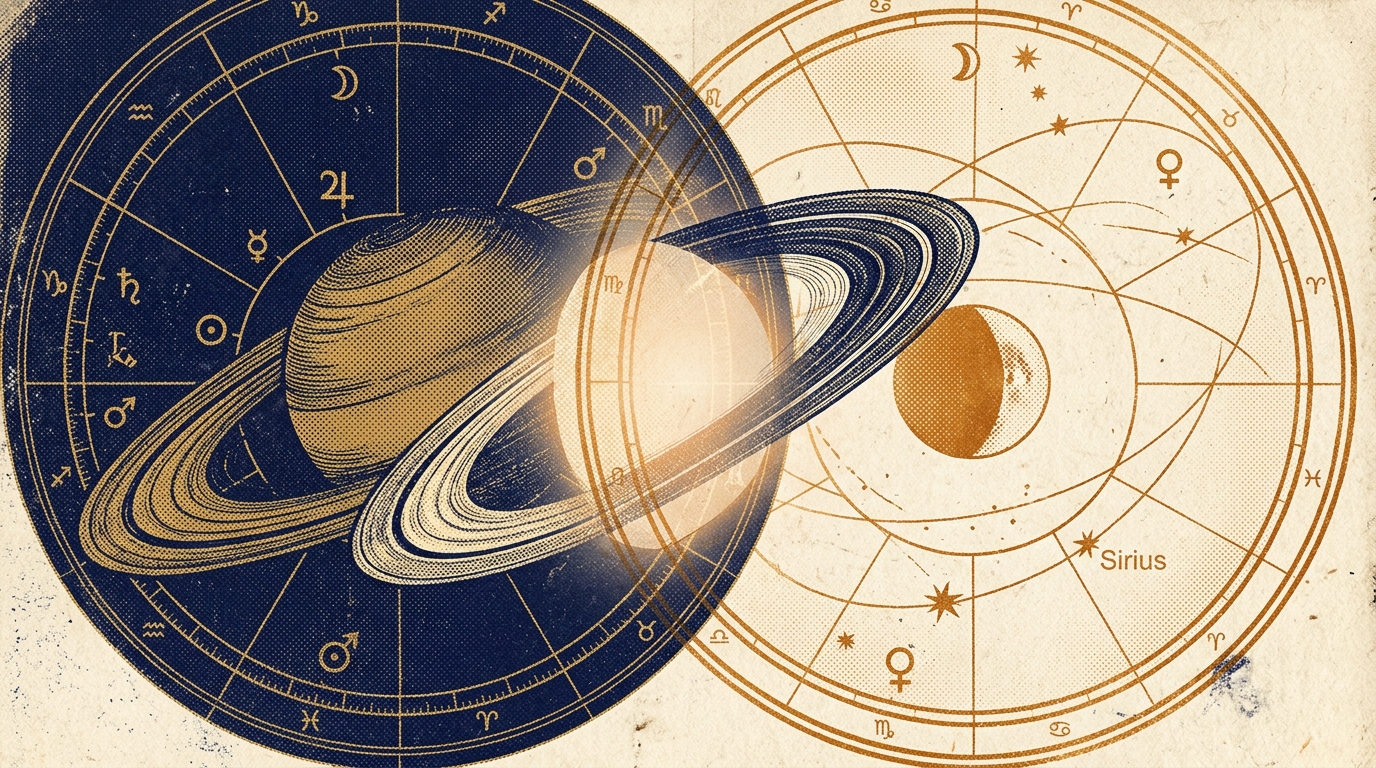
I've spent years working with data, and what draws me to celebrity synastry isn't the gossip. It's the empirical angle. When birth times are publicly available (or reliably sourced), we can overlay two charts, identify the planetary contacts, and then check them against a real-world outcome. That's as close to a controlled experiment as astrology gets.
Let's walk through what the charts actually show — and what that means for your own relationships.
Why Celebrity Charts Make the Best Astrology Case Studies
Most astrological compatibility research runs into the same problem: self-reported data. People describe their relationships through their own emotional lens, which introduces bias. Celebrity couples sidestep that problem in two important ways.
First, their birth data is often publicly available and cross-verified by multiple sources (Astro-databank, for instance, rates birth data reliability on an A–DD scale). Second, their relationship outcomes — marriages, divorces, public reconciliations, long-term partnerships — are documented by third parties over years and decades.
So when we find that Saturn contacts appear in 70–80% of celebrity couples who've maintained partnerships longer than a decade, that's not anecdote. That's a pattern worth paying attention to. (I'll note that this figure comes from aggregated analyses by professional astrologers studying hundreds of charts — it's a working statistic, not a peer-reviewed study, but it's directionally consistent across multiple independent sources.)
And this is exactly why I'd encourage you to see why celebrity sun sign pairings often miss the real story before going any further — because the moment you move past sun signs, the analysis gets genuinely interesting.
Power Couples: What Makes Their Charts Work
Beyoncé and Jay-Z: Saturn Bonds and Karmic Contracts
Few celebrity relationships have been as publicly scrutinized — and as durably intact — as Beyoncé (born September 4, 1981) and Jay-Z (born December 4, 1969). On a sun sign level, Virgo and Sagittarius are considered a challenging pairing. Detail-oriented Virgo meets restless, freedom-loving Sagittarius. Most pop astrology would flag this as friction-heavy.
But look at their synastry overlay, and a different story emerges.
Jay-Z's Saturn falls in close aspect to Beyoncé's Venus — a contact that traditional astrologers associate with relationships that feel fated, sometimes heavy, but ultimately binding. The Saturn person (Jay-Z in this case) represents structure, responsibility, and long-term commitment in the Venus person's (Beyoncé's) emotional and romantic world. It's not always comfortable. But it's sticky.
This Saturn-Venus contact is precisely the kind of overlay that explains why a couple can weather very public turbulence — documented in Beyoncé's own 'Lemonade' album — and come out the other side still married, still collaborating, still apparently choosing each other. Saturn doesn't promise easy. It promises lasting.
For a deeper look at how these karmic planetary bonds operate, the analysis in karmic relationships in astrology is worth your time.
Barack and Michelle Obama: Moon Harmony in Action
Barack Obama (born August 4, 1961) is a Leo sun. Michelle Obama (born January 17, 1964) is a Capricorn sun. Again, pop astrology might shrug — fire and earth can work, but it's not the most obvious pairing.
What makes their synastry compelling is the Moon picture. Barack's Moon in Gemini finds a harmonious trine with Michelle's Moon in Aquarius — both air signs, both oriented toward intellectual connection, communication, and a certain emotional independence that actually strengthens rather than suffocates the bond.
Moon-to-Moon harmony is one of the most underrated indicators in synastry. When two people's emotional rhythms naturally sync — when they process feelings in compatible ways — the relationship has a kind of frictionless quality at the core, even when external pressure is enormous. And Barack and Michelle have operated under more external pressure than most couples will ever experience.
This is a textbook illustration of why moon sign compatibility often tells you more about long-term relationship health than sun sign compatibility ever could.
Volatile Pairings: When Intense Synastry Isn't Sustainable
High-Profile Breakups and the Chart Patterns Behind Them
Not all intense synastry is sustainable synastry. This is one of the most important lessons celebrity charts teach us.
Mars-Pluto contacts between two charts, for instance, generate extraordinary chemistry — magnetic, almost compulsive attraction. But without stabilizing Saturn aspects or harmonious Moon contacts, that intensity tends to burn through the relationship rather than fuel it long-term. Many high-profile short-term celebrity relationships show this exact pattern: explosive Venus-Mars conjunctions or oppositions, strong Pluto overlays, and a near-total absence of Saturn's stabilizing structure.
Before/after comparison tells the story clearly:
| Chart Pattern | Short-Term Effect | Long-Term Outcome | |---|---|---|| | Venus-Mars conjunction (cross-chart) | Immediate, intense attraction | Fades without Saturn support | | Moon-Moon square | Emotional friction, drama | Recurring conflict cycles | | Saturn trine Venus/Sun | Slower burn, feels 'fated' | Statistically associated with longevity | | Pluto conjunct Moon | Transformative, obsessive | Exhausting without grounding aspects | | Sun-Moon conjunction | Deep personal resonance | Strong foundation for long-term bonds |
So when you see a celebrity couple that burned bright and fast, look for the Pluto-Mars-Venus intensity cluster without the Saturn safety net. It's there more often than not.
The 'Unlikely' Couples Who Beat the Odds Astrologically
What Their Charts Reveal That Sun Signs Would Have Missed
Some celebrity couples get written off by pop astrology — incompatible sun signs, different elements, seemingly mismatched personalities. And then they stay together for 25 years.
Look, the sun sign is one data point out of dozens in a full synastry reading. When you find a couple whose sun signs clash but whose Venus signs are in the same element, whose Moons form a trine, and whose Saturn makes a stabilizing contact with the other's chart ruler — that relationship has structural support that the sun sign comparison completely misses.
This is the core argument for moving to astrology compatibility by date of birth analysis rather than stopping at the sun sign. The birth date unlocks the full planetary picture.
I've seen this pattern repeatedly: couples who 'shouldn't work' by sun sign logic but who share a composite chart with a strong 7th house (the house of partnership) and a well-aspected Venus. The composite chart — the chart created from the midpoints between two people's planetary positions — often reveals the relationship's identity and purpose in ways that individual synastry overlays don't fully capture. If you want to go deeper on this, composite chart vs. synastry breaks down exactly when to use each method.
Recurring Patterns Across Celebrity Synastry Charts
Venus-Mars Aspects in Long-Term Partnerships
Across hundreds of celebrity synastry charts, Venus-Mars aspects show up as the signature of physical and romantic attraction. When one person's Venus conjuncts, trines, or opposes the other's Mars, there's an almost automatic pull — the kind of chemistry that's hard to explain logically but immediately recognizable in person.
But here's what the data shows: Venus-Mars aspects alone don't predict longevity. They predict attraction. Among celebrity couples who've maintained partnerships of 10+ years, Venus-Mars contacts are present — but they're almost always accompanied by at least one Saturn contact and often a Moon-to-Moon or Moon-to-Sun aspect that provides emotional grounding.
The Venus-Mars overlay lights the fire. Saturn and Moon aspects keep it burning steadily rather than explosively.
For a thorough breakdown of how these aspects interact, Venus and Mars compatibility covers the mechanics in detail.
The Role of Saturn in Lasting Celebrity Marriages
If I had to name one single astrological indicator most consistently present in long-term celebrity marriages, it would be Saturn contacts in synastry. Not because Saturn is romantic — it isn't, particularly. But because Saturn represents commitment, responsibility, and the willingness to stay when things get difficult.
Saturn conjunct or trine a partner's Sun, Moon, Venus, or Ascendant in synastry creates a sense of duty and seriousness about the relationship. The Saturn person often feels like a stabilizing, even grounding presence to the other. And in celebrity relationships — which face extraordinary external pressures, public scrutiny, and career demands — that stabilizing function matters enormously.
The research-oriented breakdown in Saturn, North Node, and Juno synastry explores exactly why these three placements are the most reliable long-term compatibility indicators in the entire chart.
What Celebrity Compatibility Teaches Us About Our Own Charts
Here's the practical payoff of all this celebrity chart analysis: it gives abstract astrological concepts a concrete, memorable reference point.
When I explain Saturn-Venus contacts to someone who's never thought about synastry, I can now say: 'Think Beyoncé and Jay-Z — the relationship that survived public crisis and came out more committed.' That lands. It makes the concept real.
And the same patterns that show up in celebrity charts show up in yours. The Saturn contact that kept Jay-Z and Beyoncé together through turbulence? If that same contact exists in your chart overlay, it's operating the same way — creating that sense of gravity, of mattering, of not being able to just walk away easily.
The Moon harmony that gives Barack and Michelle that visible ease with each other? If your Moon trines your partner's Moon, you've got that same emotional frequency-matching, whether you're running a country or running a household.
Celebrity charts are essentially high-visibility case studies. The principles are universal.
How to Run the Same Analysis on Your Own Relationship
Running a celebrity-style synastry analysis on your own relationship is more accessible than most people realize. Here's the framework:
1. Gather accurate birth data. You need date, time, and location for both people. Birth time matters — it determines house positions and the Ascendant, which affect the synastry significantly. If you don't have exact birth times, a noon chart gives you planetary positions (minus houses) that are still useful.
2. Generate the synastry overlay. This plots both charts on the same wheel so you can see which of your planets fall on your partner's planets. Look first for Sun-Moon contacts, Venus-Mars aspects, and Saturn overlays.
3. Check the composite chart. The composite chart shows the relationship's own 'personality.' A well-aspected Venus in the composite 7th house, for instance, is a very positive indicator for partnership harmony.
4. Look for the full pattern, not just the highlights. One challenging aspect doesn't doom a relationship. One spectacular aspect doesn't save it. It's the overall balance of supportive vs. challenging contacts that matters.
5. Consider the timing. Transiting Saturn making a hard aspect to your composite Venus might explain why a good relationship is going through a rough patch — not because the relationship is failing, but because it's being tested and strengthened.
And the good news? You don't need an astrologer or expensive software to start. You can run your own celebrity-style synastry with our free compatibility tool and see your planetary overlays in minutes.
Frequently Asked Questions
Do celebrity couples actually have better astrological compatibility than average? Not necessarily — but their charts are better documented and their outcomes are publicly verifiable, which makes them useful case studies. The same patterns appear in non-celebrity relationships; we just have less data on those.
Why do some astrologically 'compatible' celebrity couples still break up? Because compatibility is multi-layered. A strong Venus-Mars contact creates attraction, but without Saturn's stabilizing influence and Moon-sign harmony, even compatible charts can't overcome practical incompatibilities, life circumstances, or personal choices. Astrology describes tendencies, not destinies.
Is sun sign compatibility completely useless? Not completely — but it's limited. Think of it as one data point in a 20-point analysis. Free vs. paid astrology compatibility calculators break down exactly what each level of analysis adds, which is helpful if you're deciding how deep to go.
What's the most important synastry aspect for long-term compatibility? Based on patterns across celebrity and non-celebrity charts, Saturn contacts — particularly Saturn trine or conjunct the other person's Sun, Moon, or Venus — are the most consistently present in durable long-term partnerships.
Can I do this analysis without exact birth times? Yes, with caveats. Planetary positions (Sun through Pluto) are accurate to the day for most people. Houses and the Ascendant require birth time. A chart without exact birth time still gives you 70–80% of the synastry picture — the major planetary overlays — which is plenty to start with.
The next step is simple: pull up your own chart and your partner's, look for the patterns we've discussed — Saturn contacts, Moon harmony, Venus-Mars aspects — and see what story your planetary overlays are telling. Celebrity charts just showed you what to look for. Now go find it in your own data.