Roughly 80% of people who search for a compatibility tool online never see a single line of Saturn data. They get a percentage score, a color-coded wheel, or a sun-sign blurb — and walk away thinking they've done the work. They haven't.
Saturn is the planet most consistently linked to relationship longevity, karmic obligation, and long-term structure. If you're serious about understanding what a relationship is built on — or built to teach you — Saturn interaspects are non-negotiable data points. And most tools simply don't show them.
This comparison evaluates the most-used free and freemium synastry tools specifically on their ability to surface Saturn contacts. Not general compatibility. Not sun-sign matching. Saturn.
Why Most Free Compatibility Tools Fall Short on Saturn Analysis
Free tools are built for conversion, not depth. A quick score or a shareable result keeps users engaged and coming back. Detailed Saturn analysis — which requires birth time, house system selection, and orb customization — creates friction.
So most tools skip it.
Sun-sign compatibility engines are the worst offenders. They don't use birth charts at all. But even chart-based tools often limit their output to the 'headline' aspects: Sun-Moon, Venus-Mars, maybe Ascendant contacts. Saturn gets buried or omitted entirely.
Here's the thing: Saturn interaspects aren't rare or exotic. Saturn conjunct someone's Moon, or Saturn falling in a partner's 7th house — these show up constantly in long-term couples' charts. Ignoring them isn't a minor gap. It's a structural blind spot.
For a broader look at what Saturn synastry actually reveals, start with understanding what Saturn synastry reveals about long-term compatibility.
What a Saturn-Aware Synastry Tool Actually Needs to Show
Before comparing tools, it helps to define the minimum viable feature set. Not every tool needs to do everything. But if it can't do these three things, it's not useful for Saturn analysis.
Interaspect Detection: Does It Identify Saturn to Personal Planet Contacts?
The tool must identify when one person's Saturn forms a major aspect (conjunction, opposition, square, trine, sextile) to the other person's Sun, Moon, Mercury, Venus, Mars, or Ascendant. These are the contacts that define the Saturn story in a relationship.
Bonus points if it catches Saturn-to-outer-planet aspects (Saturn conjunct Pluto, Saturn opposite Uranus) and Saturn-to-North Node contacts — the latter being especially significant for karmic relationship patterns.
House Overlay Mapping: Does It Show Which House Saturn Falls In?
House overlays show where one person's planets land in the other's chart. If your partner's Saturn falls in your 4th house, that's a different dynamic than their Saturn in your 11th. The house placement contextualizes the aspect's theme.
This requires accurate birth times from both parties. Tools that work without birth times can't do this — and should say so clearly.
Interpretation Depth: Does It Explain What the Aspect Means?
Raw aspect data is a starting point, not a destination. A good tool tells you what Saturn square Moon actually means in a relationship context — not just that it exists. Ideally, it distinguishes between the 'Saturn person' and the 'Moon person' experience, since the dynamic is asymmetric.
Tool-by-Tool Comparison: How Popular Synastry Calculators Handle Saturn
| Tool | Best For | Saturn Interaspects | House Overlays | Interpretation Quality | Free Access |
|---|---|---|---|---|---|
| Astro.com | Advanced users, full data | ✅ Complete | ✅ Full overlay grid | Minimal (DIY) | Free with registration |
| Café Astrology | Readable interpretations | ✅ Major aspects | ⚠️ Limited | ✅ Strong written reports | Fully free |
| AstroSeek | Quick interaspect scanning | ✅ Full grid | ✅ Shown | ⚠️ Variable quality | Fully free |
| Generic apps (Co-Star, etc.) | First impressions | ❌ Rarely shown | ❌ Not shown | ⚠️ Vague | Free (freemium) |
| Dedicated zodiac calculators | Speed + Saturn focus | ✅ When built for it | ✅ When built for it | ✅ Contextual | Varies |
Astro.com: Comprehensive but Steep Learning Curve
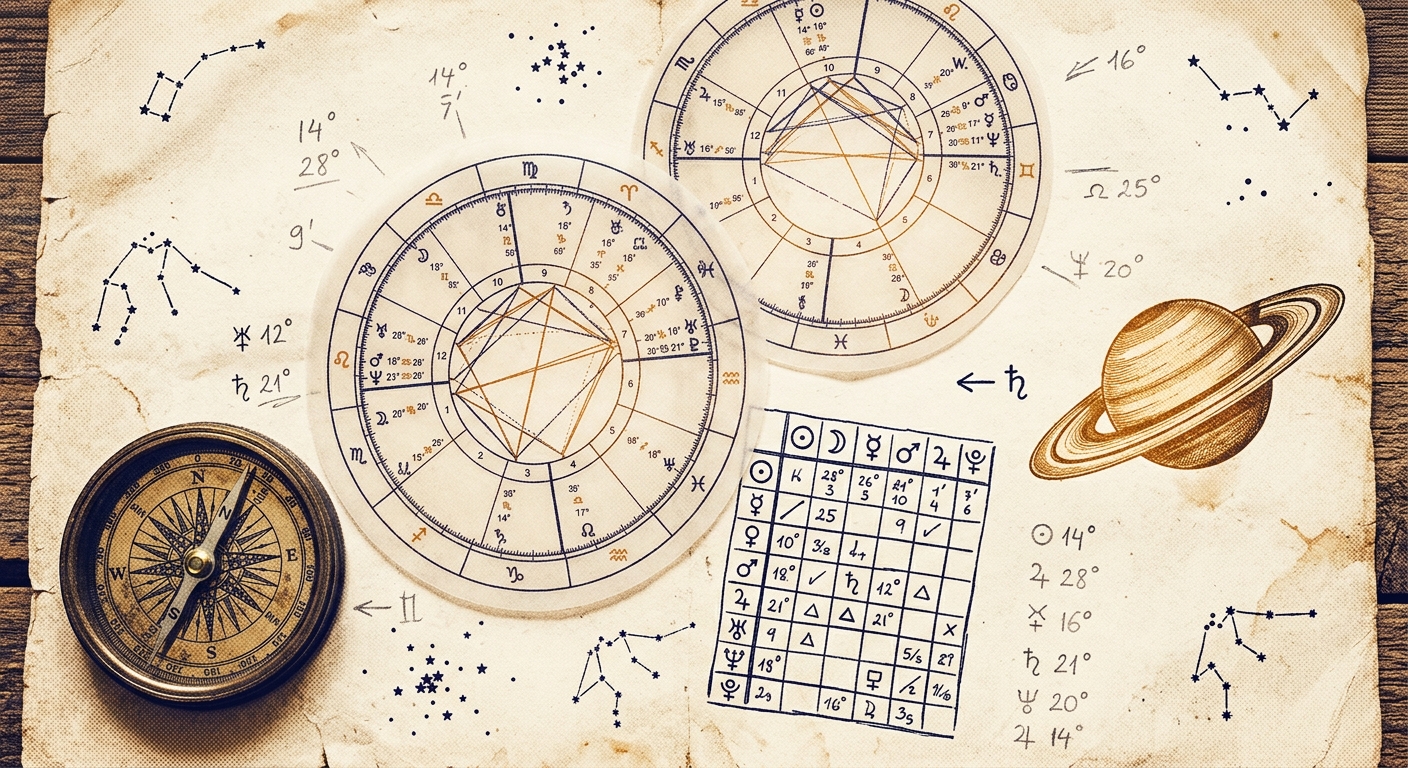
Astro.com is the gold standard for raw astrological data. Its synastry function generates a full bi-wheel chart plus an interaspect table that includes every Saturn contact — Saturn conjunct Venus, Saturn square Moon, Saturn trine Sun — all listed with exact orbs.
The house overlay grid is also available, showing exactly where each planet falls in the partner's houses. This is the most complete Saturn synastry dataset you'll get for free.
But. The interface assumes you already know what you're looking at. There's no guided interpretation of Saturn aspects. You get the data; you supply the meaning. For someone new to synastry, this creates a significant gap between information and insight.
In my experience, Astro.com works best as a data source that you pair with external interpretation resources. Pull the interaspect table, identify the Saturn contacts, then look them up elsewhere.
Café Astrology: Accessible Interpretations, Limited Customization
Café Astrology's synastry report is one of the most readable free tools available. It generates written paragraph interpretations for each aspect — including Saturn aspects to personal planets — in plain language that doesn't require prior astrology knowledge.
The Saturn-Moon interpretation, for example, distinguishes between the stabilizing and restricting expressions of the aspect. That nuance matters, and Café Astrology delivers it.
The limitations: you can't customize orbs, the tool doesn't always catch minor aspects (semisextile, quincunx), and the house overlay section is less developed than the aspect interpretations. And the site's design is dated enough that finding the right synastry tool takes some navigation.
Still — for someone who wants to understand what their Saturn contacts mean without decoding chart jargon, Café Astrology is genuinely useful.
AstroSeek: Strong Interaspect Tables, Variable Interpretation Quality
AstroSeek sits between Astro.com and Café Astrology in terms of balance. Its synastry tool generates a full interaspect grid — rows and columns for each person's planets, with aspect symbols at the intersections. Saturn contacts are clearly visible and filterable.
The house overlay section is also present and shows which house each planet activates in the partner's chart. For a free tool, this is genuinely impressive coverage.
Where AstroSeek falls short is interpretation consistency. Some aspect write-ups are detailed and accurate. Others are thin or feel algorithmically generic. Saturn square Mars gets a reasonable treatment; Saturn opposite Venus is thinner than it should be. (It's worth checking multiple sources if AstroSeek is your primary tool.)
AstroSeek is probably the best free starting point for users who want to scan for Saturn contacts quickly without a steep learning curve.
Dedicated Compatibility Calculators: Speed vs. Depth Trade-Off
Apps like Co-Star, Pattern, and similar mobile-first tools prioritize experience over depth. They generate personalized-feeling outputs quickly — but Saturn interaspects are rarely surfaced explicitly. You might see a general 'structure' or 'challenge' label, but the underlying Saturn contact is usually not named.
For someone doing serious Saturn synastry research, these tools are a dead end. They're not built for it.
Dedicated zodiac compatibility calculators that are built specifically around chart-level analysis are a different story. Try our synastry calculator to surface your Saturn interaspects instantly — it's designed to show Saturn contacts explicitly, including house overlays, rather than burying them in a generic score.
For a deeper look at how Saturn in specific houses operates, the article on Saturn in the 7th house synastry is worth reading alongside any tool output you generate.
What to Look for When Choosing a Tool for Saturn Synastry Research
Four criteria matter most:
1. Explicit Saturn labeling. The tool should name Saturn contacts directly — not fold them into a generic 'karmic' or 'challenge' category. If you can't see 'Saturn conjunct Moon' as a discrete line item, the tool isn't showing you enough.
2. Orb control. Saturn aspects are meaningful within roughly 6-8 degrees. Some tools use tighter orbs by default and miss valid contacts. Others use 10+ degree orbs and generate noise. Adjustable orbs are a sign of a serious tool.
3. Both directions. Synastry is bidirectional. Your Saturn to their Moon is different from their Saturn to your Moon. A good tool shows both. Many don't — they generate one-directional reports that miss half the picture.
4. House system clarity. House overlays depend on which house system is used (Placidus, Whole Sign, Koch). The tool should tell you which system it's using. If it doesn't, treat the house data with caution.
For context on how Saturn compares to other relationship planets in synastry, the comparison in Saturn synastry vs. Venus synastry is a useful frame.
How to Manually Verify Saturn Aspects If Your Tool Misses Them
If you're using a tool that doesn't surface Saturn contacts clearly, here's a manual method that takes about five minutes.
First, pull both natal charts from Astro.com (free, no interpretation needed — just the planet degree listings). Note the exact degree and sign of each person's Saturn.
Then check the other person's personal planets (Sun, Moon, Mercury, Venus, Mars, Ascendant) for placements within 6-8 degrees of that Saturn position — in the same sign (conjunction), opposite sign (opposition), or square signs (90° apart).
A Saturn at 14° Capricorn forms a conjunction with anything between 6°-22° Capricorn, an opposition with anything in Cancer in that range, and squares to Aries or Libra in that range.
This takes practice but is reliable. And it gives you a baseline to compare against whatever your tool reports.
For more on reading synastry charts without getting lost, how to read a synastry chart for beginners covers the fundamentals clearly.
Recommendation: The Best Starting Point for Saturn Synastry Analysis
Here's the practical answer:
If you want the most complete raw data: Use Astro.com's synastry function. Download the interaspect table. Look for every row or column that includes Saturn. Cross-reference with Café Astrology's written interpretations for those specific aspects.
If you want a readable, all-in-one report: Café Astrology's synastry report is your best free option, with the caveat that you should double-check house overlays on AstroSeek.
If you want a fast Saturn-specific scan: AstroSeek's interaspect grid is the quickest way to identify all Saturn contacts at a glance. Use it as a checklist, not a final analysis.
If you want Saturn interaspects surfaced automatically with context: Try our synastry calculator to surface your Saturn interaspects instantly — it's built to prioritize the placements that actually predict relationship longevity and karmic weight, rather than making you dig for them.
And regardless of which tool you use — cross-check the output. Saturn aspects are too significant to rely on a single source. The best analysts I know use two tools minimum and treat discrepancies as a prompt to go deeper, not a reason to dismiss one result.
For a ranked view of which Saturn aspects carry the most weight in long-term compatibility, the breakdown in best synastry aspects for marriage ranked gives you a concrete priority list to work from.