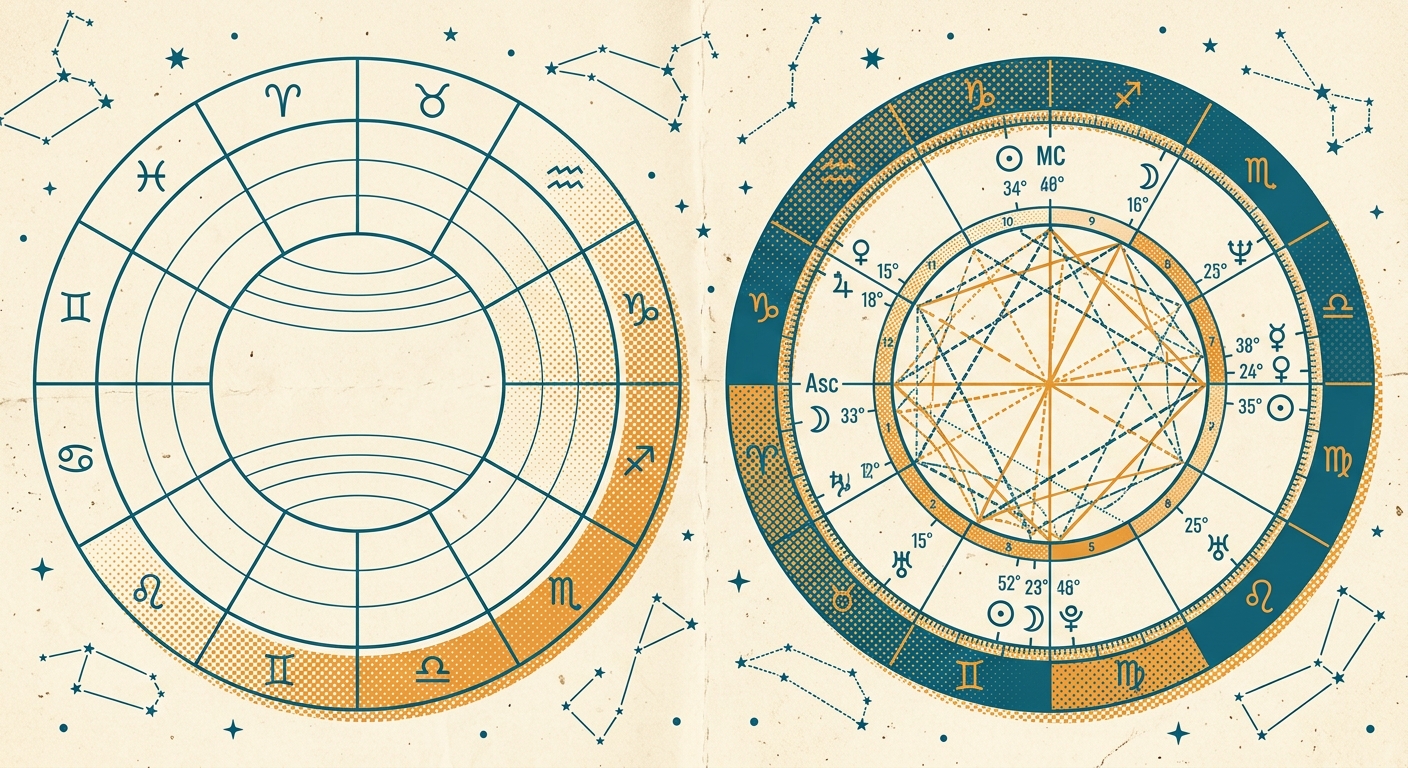
Most people searching for a composite chart calculator assume the hard part is finding a free one. It's not. Free tools are everywhere. The hard part — the part almost nobody talks about — is figuring out which ones actually tell you something useful once the chart is generated.
According to a 2025 survey by The Mountain Astrologer, over 60% of astrology enthusiasts report running composite charts but feeling unclear about how to interpret what they're looking at. That's not a knowledge problem. That's a tool problem. The calculators they're using generate beautiful wheel graphics and then... stop. No interpretation. No context. No explanation of what a Saturn conjunct Venus in the 5th house actually means for the relationship.
So before you spend another hour copy-pasting birth data into a calculator that gives you a pretty chart and nothing else, let's look at what these tools actually offer — and which one is worth your time based on what you actually need.
What to Expect From a Composite Chart Calculator
Calculation Method: Midpoint vs. Davison Chart
Here's something most tool comparisons skip entirely: not all composite charts use the same math.
The two dominant methods are the midpoint composite and the Davison chart. The midpoint method, developed by Robert Hand and others in the 1970s, calculates the mathematical midpoint between each planet in two birth charts, creating a theoretical third chart that represents the relationship itself. The Davison chart, by contrast, calculates a literal date-and-location midpoint — an actual moment in time and space that represents the relationship's 'birth.'
These two methods can produce notably different charts, especially in house placements. And most free calculators default to the midpoint method without telling you this is a choice you're making. (I've seen users run a Davison chart on Astro-Seek and compare it to a midpoint composite on Astro.com and conclude the tools are broken, when they're actually doing different things.)
For a deeper look at how composite charts relate to synastry analysis as a whole, the composite chart vs synastry: choosing the right analytical method breakdown is worth reading before you commit to any single tool.
If you want to explore the Davison method specifically, the comparison at /blog/composite-chart-vs-davison-chart-comparison-synastry-which/ goes deep on when each approach produces more reliable results.
What 'Interpretation' Actually Means in a Calculator Context
Interpretation in an astrology tool context means written, contextual explanation of what specific placements mean — not just a list of planets and degrees.
A tool that gives you 'Sun in Libra, 7th house' with no additional text is not providing interpretation. A tool that says 'The composite Sun in the 7th house suggests a relationship built around partnership as a core identity, where both people define themselves through the connection' is providing interpretation.
The gap between these two experiences is enormous. And most free composite chart calculators live on the wrong side of that gap.
The Major Free Composite Chart Tools: A Feature-by-Feature Breakdown
| Tool | Calculation Method | Interpretation Depth | Synastry Integration | Best For | Limitations |
|---|---|---|---|---|---|
| Astro.com | Midpoint (default) + Davison option | Minimal free; deep in paid reports | Yes, separate synastry chart available | Advanced users, researchers | Steep learning curve, UX is dated |
| Cafe Astrology | Midpoint | Moderate — good written blurbs | No direct integration | Beginners wanting context | Less customization, no asteroid options |
| Astro-Seek | Midpoint + Davison | Thin — keyword-level only | Partial — can run both separately | Visual learners, asteroid enthusiasts | Interpretations are shallow |
| Co-Star | Proprietary algorithm | Moderate — app-based narrative | Integrated but non-transparent | Casual users, social sharing | No exportable chart, closed system |
| Pattern | Proprietary algorithm | Moderate — psychological framing | Integrated but non-transparent | Psychology-adjacent users | Limited astrological depth, paid premium |
| Our Calculator | Midpoint | Deep — full placement interpretations | Yes — synastry + composite paired | Users wanting complete analysis | Requires accurate birth times |
Astro.com: Depth and Customization for Serious Users
Astro.com is the gold standard for chart generation, full stop. Its composite chart function lets you choose between midpoint and Davison methods, customize house systems, add asteroids, and adjust orbs. For someone who knows what they're doing, it's unmatched.
But here's the thing: Astro.com's free interpretation layer is thin. You get the chart. You get a list of placements. And then you're largely on your own unless you purchase an individual report (typically $15–$35 depending on depth). The free 'Extended Chart Selection' doesn't auto-generate written composite interpretation — you're expected to either know how to read it or buy the report.
So if you're a self-taught intermediate or advanced astrologer who just needs accurate chart generation and will do your own analysis, Astro.com is the right tool. If you need the tool to explain what you're looking at, you'll hit a wall quickly.
Cafe Astrology: Accessible Interpretation for Beginners
Cafe Astrology occupies a genuinely useful middle ground. Its composite chart calculator is simpler than Astro.com — fewer options, no method switching, no asteroid customization — but it compensates with readable, contextualized text for major placements.
For a beginner running their first composite chart with a new partner, Cafe Astrology's written blurbs are genuinely helpful. They explain what Venus in the 12th house means for how a couple handles intimacy, what a composite Mars-Saturn square suggests about conflict patterns, and so on. They're not exhaustive, and they don't integrate synastry context, but they answer the basic question: 'what does this actually mean?'
The limitation is ceiling, not floor. Once you want to go deeper — cross-referencing composite placements with individual synastry aspects, or understanding how the composite chart's Saturn placements relate to each person's natal Saturn — Cafe Astrology doesn't give you the tools to do that.
Astro-Seek: Visualization and Extra Asteroid Options
Astro-Seek has carved out a niche as the most visually generous free tool. Its composite chart displays are clean, the interface handles multiple chart types, and it includes asteroid options (Chiron, Juno, Lilith, and others) that you won't find in basic calculators.
But its interpretation layer is genuinely thin. Astro-Seek tends to offer keyword-level descriptions rather than contextual explanations — you might see 'communication-focused' next to Mercury in Gemini, but not an explanation of what that means when it's in the composite 3rd house of a relationship with significant Saturn pressure elsewhere.
For users who want to include Juno or Chiron in their composite analysis (and there are strong reasons to — the marriage indicators and placements in composite charts analysis covers why Juno specifically matters), Astro-Seek is worth running alongside a more interpretation-heavy tool.
Co-Star and Pattern: App-Based Composite Approaches
Co-Star and Pattern are genuinely different animals. Neither provides a traditional composite chart in the academic sense — they use proprietary algorithms to generate relationship compatibility analysis that draws on composite-style logic, but the underlying methodology isn't fully transparent.
Co-Star's relationship feature generates narrative text about how two people interact, framed around planetary aspects and house placements. The writing is sharp and often accurate in tone, and the social-sharing design means people engage with it frequently. But you can't export a chart, study the degrees independently, or cross-reference their analysis against your own reading.
Pattern leans more psychological, framing compatibility in terms of communication patterns, attachment, and growth areas. It's a solid product for people who are skeptical of traditional astrology but curious about the framework. And it's integrated well enough that the paid tier feels worth it for casual users.
But neither Co-Star nor Pattern is a substitute for a real composite chart if you want actual astrological study. They're interpretive products that use astrological input, not transparent tools you can work with directly.
What Free Tools Get Right — and Where They Fall Short
Accuracy of Birth Data Input and Time Zone Handling
This matters more than most people realize. A composite chart is only as accurate as the birth data you feed it, and time zone handling is where many free tools make quiet errors.
Astro.com is the most rigorous here — it has a comprehensive location database that handles historical time zone changes and daylight saving time adjustments accurately. If someone was born in Indiana in 1987 (a notoriously complex time zone situation for that era), Astro.com is more likely to calculate it correctly than a simpler tool.
Cafe Astrology and Astro-Seek are generally accurate for standard time zones but can struggle with historical edge cases. Co-Star and Pattern handle birth data input through a UX-friendly interface, but since the calculation is opaque, it's harder to verify whether edge cases are handled correctly.
Bottom line: if birth times are uncertain, every tool will produce uncertain results. No calculator can fix a 2-hour birth time uncertainty, and a composite chart built on approximate birth times should be read with significant caution for time-sensitive placements like house positions and the Ascendant.
Depth of Written Interpretation Provided
This is the defining variable for most users, and the range is striking.
At the minimal end: tools that give you a chart and a list of aspects with no explanation. At the rich end: tools that provide multi-paragraph interpretations for each planet in house, major aspect interpretations, and an overall synthesis of the chart's themes.
Free tools almost universally sit at the minimal-to-moderate range. The economics make sense — deep interpretation is the premium product. But for users trying to actually understand what their composite chart means for their relationship, the gap between 'chart generator' and 'chart interpreter' is where most people get stuck.
For a fuller framework on reading composite charts alongside synastry, the synastry chart interpretation guide offers useful methodology that applies to composite reading as well.
Integration With Synastry Analysis
Here's where most free tools fail the test of serious relationship analysis: they treat composite charts and synastry as entirely separate products.
But sophisticated astrologers rarely read a composite chart in isolation. The composite chart tells you what the relationship is. The synastry tells you how the two individuals experience each other. Reading them together is where the real insight lives.
Astro.com lets you run both, but you're switching between separate chart outputs and doing the synthesis yourself. Cafe Astrology and Astro-Seek don't natively integrate the two. Co-Star and Pattern have the most integrated experience but the least transparent methodology.
If you want both layers analyzed together — which I think most people actually need — try our composite chart calculator with full interpretation which pairs composite and synastry analysis in the same report.
Paid Composite Chart Reports: Are They Worth the Upgrade?
For most casual users: probably not. For anyone in a significant relationship who wants to understand the deeper patterns at play: probably yes.
Paid composite reports — whether from Astro.com, Cafe Astrology, or dedicated services — typically offer 20–50 pages of interpretation, covering every planet in house, major aspects, patterns, and often a synthesis section. The quality varies significantly by provider. Astro.com's paid reports are algorithmically generated from Robert Hand's and other authors' delineation text and are generally reliable. Some third-party paid services charge $40–$80 for reports that are essentially the same algorithmic output with a different interface.
The honest answer is that a good paid composite report is worth it once — as an orientation to what you're looking at. After that, the skill you're building is interpretation, not report-generation, and that requires studying charts yourself rather than outsourcing the reading.
How to Get the Most Out of Any Composite Chart Calculator
Regardless of which tool you use, a few practices will significantly improve the quality of what you get out of it.
Verify birth data before running the chart. This sounds obvious, but birth certificate times differ from family memory more often than you'd think. A 15-minute error in birth time can shift house cusps meaningfully in a composite chart.
Identify the chart's dominant themes first. Before reading individual aspects, look for patterns: which houses are heavily tenanted? Are there stellia (clusters of planets in one sign or house)? What's the composite Moon sign and house? These broad strokes tell you what the relationship's core energy is before you drill into specifics.
Cross-reference with synastry. The composite chart's Venus placement tells you something about the relationship's love style. The synastry between your Venus and your partner's Moon tells you something about the emotional texture of how you receive that love. You need both.
Don't over-interpret difficult aspects. A composite Saturn-square-Sun isn't a death sentence for a relationship — it's an indicator of the work the relationship asks of both partners. Context matters enormously, and free tool interpretations sometimes lack the nuance to convey this.
And look, if you're genuinely invested in understanding what a composite chart means for a specific relationship, one tool isn't going to get you there. Use Astro.com for the most accurate chart generation, Cafe Astrology for a first-pass written interpretation, and a more integrated tool for the synthesis.
Our Recommendation Based on Your Goal
So, which tool should you actually use?
If you're brand new to composite charts: Start with Cafe Astrology. The written interpretations are accessible, the interface is forgiving, and you'll build a working vocabulary for what you're looking at without getting lost in options.
If you're an intermediate or advanced astrologer: Use Astro.com for chart generation. It's the most accurate, the most customizable, and the most respected in the astrological community. Pair it with your own interpretation or a paid report for the analysis layer.
If you want asteroid integration: Run Astro-Seek alongside whatever primary tool you're using. Its Juno, Chiron, and Lilith composite placements add a layer that most tools ignore entirely.
If you want both composite and synastry interpretation in a single report: That's exactly what try our composite chart calculator with full interpretation is built for. You input both birth charts, and the output pairs composite planet interpretations with the synastry aspects that contextualize them — so you're not just seeing where composite Venus lands, you're understanding how each partner's individual chart shapes that placement.
The broader question of what composite charts can and can't tell you — and how they stack up against synastry for relationship assessment — is covered in the composite chart vs synastry: choosing the right analytical method article, which is worth reading before you commit to any single analytical method.
The right tool is the one that matches your actual goal. Don't default to the most popular option just because it shows up first in search results. Most people aren't getting meaningful answers from their composite charts not because astrology doesn't work, but because their tool stopped at the chart and left the interpretation entirely to them.