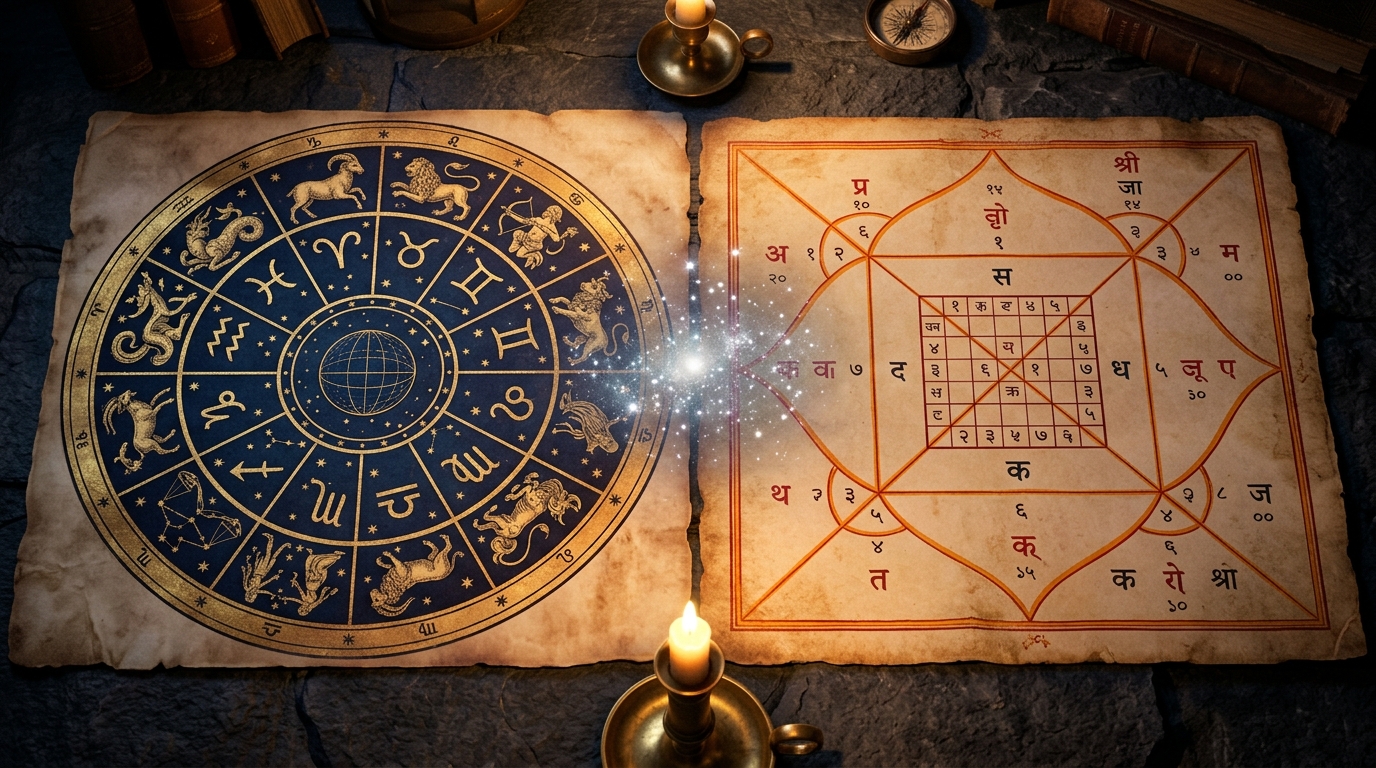
Most people discover the problem by accident. They're filling out a compatibility form, or reading their horoscope on a new app, and suddenly they're being called a Pisces when they've identified as an Aries their entire life. No warning, no explanation — just a different sign staring back at them.
This isn't a glitch. It's the fault line between two sophisticated astrological traditions that have been calculating the sky differently for centuries. And that fault line runs directly through every compatibility reading you've ever received.
Why Your Sign Changes Depending on Which System You Use
The zodiac is not a fixed thing painted on the sky. It's a coordinate system — a way of dividing the ecliptic (the apparent path of the Sun through the year) into twelve equal segments. The question both traditions had to answer was: where do you start counting?
Western astrology anchors the zodiac to the seasons. Aries begins at the spring equinox, every year, without exception. Vedic astrology anchors the zodiac to the actual star constellations — specifically, to a reference star called Spica in the constellation Virgo. These two starting points were roughly aligned about 2,000 years ago. Since then, due to a slow wobble in Earth's axis called the precession of the equinoxes, they've drifted apart by approximately 23 degrees.
Twenty-three degrees is almost one full zodiac sign.
So if you were born with the Sun at 10 degrees Aries in Western astrology, your Vedic chart places the Sun at roughly 17 degrees Pisces. You haven't changed. The sky hasn't changed. The math just starts from a different reference point.
The Core Difference: Tropical vs. Sidereal Zodiac
The Western system uses what's called the tropical zodiac — rooted in Earth's relationship to the Sun, tied to the seasons. The Vedic system uses the sidereal zodiac — rooted in the actual positions of stars as seen from Earth right now.
Neither is wrong. They're measuring different things.
What the 23-degree shift actually means for your chart
For most people born between the 1st and 20th of any month, the Sun sign stays the same across both systems. If you're a mid-Scorpio in Western astrology, you're probably still a Scorpio in Vedic. But if you're born near a cusp — say, the last week of any sign — you almost certainly shift back by one sign in the Vedic system.
The shift doesn't only affect your Sun sign. Every planet in your chart moves back by roughly 23 degrees. Your Venus, Mars, Moon, rising sign — all of it recalculates. A person with Venus in Libra (Western) might have Venus in Virgo (Vedic), which tells a completely different story about how they approach love and partnership.
Why most Western astrologers use tropical and most Vedic astrologers use sidereal
This isn't really a debate anymore — it's a division of practice. Western astrology evolved in the Hellenistic tradition and later through European Renaissance scholarship, where the symbolic connection between seasons and psychological archetypes took precedence over stellar precision. Carl Jung's influence on modern Western astrology deepened this psychological orientation.
Vedic astrology — called Jyotish in Sanskrit, meaning "science of light" — developed within the Indian philosophical tradition, where precise astronomical calculation was tied to religious ritual, karma, and dharma. Accuracy to the stars wasn't optional; it was the point. Vedic astrology uses the sidereal zodiac for compatibility precisely because the system was built on celestial mechanics, not seasonal metaphor.
This is why the two systems answer different questions. And it matters enormously when you're trying to understand a relationship.
How Western Astrology Reads Compatibility
Western compatibility analysis is fundamentally psychological. It asks: how do these two people's inner worlds interact?
Synastry, composite charts, and planetary aspects
The main tool is synastry — overlaying one person's birth chart onto another's and examining the geometric angles (aspects) between their planets. Venus conjunct Mars between two charts suggests magnetic attraction. Saturn square someone's Moon can indicate emotional friction or a sense of being constrained. The Sun trine Sun is easy, harmonious energy; the Sun opposite Sun creates tension that can be either magnetic or exhausting.
For a deeper look at what Western astrology looks at when comparing two charts, the system goes well beyond Sun signs — it's examining the full architecture of how two people's psyches fit together.
The composite chart takes a different approach: it mathematically blends the two charts into a single chart representing the relationship itself as an entity. Composite charts and synastry serve different purposes — one shows how you interact, the other shows what the relationship becomes.
Western compatibility also looks hard at Mercury placements (how you communicate), Venus (what you value and how you love), and Mars (desire, drive, conflict style). The Mercury sign is often the hidden culprit in relationships that look good on paper but break down in daily conversation.
What Western astrology largely ignores: the Moon's position in specific lunar mansions, the karmic debt framework, and any formal point-scoring system for compatibility.
How Vedic Astrology Reads Compatibility
Vedic compatibility analysis is fundamentally karmic. It asks: are these two souls meant to be together, and what is the nature of their bond?
Kundli matching: the 36-point Ashtakoot system explained
The centerpiece of Vedic compatibility is Kundli matching (also called Guna Milan), a systematic analysis that assigns points across eight categories called Kootas. The maximum score is 36 points. Here's what each Koota examines:
| Koota | Points Available | What It Measures |
|---|---|---|
| Varna | 1 | Spiritual compatibility and ego balance |
| Vashya | 2 | Mutual attraction and control |
| Tara | 3 | Health and longevity of the relationship |
| Yoni | 4 | Sexual and physical compatibility |
| Graha Maitri | 5 | Intellectual and emotional friendship |
| Gana | 6 | Temperament match (divine, human, or demonic nature) |
| Bhakoot | 7 | Emotional and financial compatibility |
| Nadi | 8 | Genetic and health compatibility, progeny |
A score below 18 is generally considered inauspicious. 18-24 is acceptable. 24-32 is good. Above 32 is considered excellent — and genuinely rare.
This isn't a casual calculation. Traditional families in India have used this system for centuries to evaluate proposed marriages, and many astrologers still consider a Nadi score of zero (both partners sharing the same Nadi) a serious concern, regardless of how high the overall score is.
Janam Kundali and what it reveals about relationship karma
The Janam Kundali (birth chart) in Vedic astrology contains layers of information that Western charts don't typically analyze. The 7th house and its lord indicate the nature of one's spouse and marriage. The condition of Venus (for men) and Jupiter (for women) in the chart reveals what kind of partner one is destined to attract. Malefic planets in the 7th house — particularly Saturn, Rahu, or Ketu — can indicate delays, difficulties, or unusual circumstances in marriage.
Vedic astrology also examines Mangal Dosha — the condition of Mars in certain houses (1st, 2nd, 4th, 7th, 8th, or 12th) that is believed to create friction or even danger in marriage if not matched with a partner who also has Mangal Dosha. This is a concept with no equivalent in Western practice.
For those interested in karmic patterns in relationships, the Vedic framework offers a more explicit vocabulary — the relationship isn't just psychologically compatible or incompatible, it's karmically appropriate or not.
Nakshatras: the lunar mansions Western astrology ignores
Perhaps the most distinctive feature of Vedic compatibility is the use of Nakshatras — 27 lunar mansions that divide the zodiac into smaller segments based on the Moon's daily movement. Each Nakshatra has a ruling deity, a symbol, and specific relational qualities.
The Kundli compatibility score is calculated primarily from the Moon's Nakshatra in each person's chart, not the Sun sign. This is a fundamental difference: Vedic compatibility is Moon-centric, while Western compatibility tends to be Sun-centric (or at least Sun-inclusive).
The Moon's Nakshatra reveals emotional nature, instinctive responses, and what a person needs to feel secure — all of which are arguably more relevant to long-term partnership than the Sun's sign.
Same Couple, Two Readings: A Comparison
Consider a hypothetical couple: Person A born March 18, Person B born September 22.
In Western astrology, Person A is a Pisces Sun and Person B is a Virgo Sun — an opposition, which Western astrology reads as both challenging and magnetically complementary. The analysis would examine their Venus signs, Moon signs, and how their charts interlock through synastry aspects.
In Vedic astrology, both charts shift back roughly 23 degrees. Person A becomes an Aquarius Sun; Person B becomes a Leo Sun. The opposition remains (Aquarius-Leo is also an opposition), but the character of each sign differs significantly from the Western interpretation. More importantly, the Kundli matching would focus on their Moon Nakshatras — which might yield a score of 28/36, indicating strong compatibility — while the Western synastry might flag a difficult Saturn-Venus square between their charts.
Same couple. One system says watch out for emotional distance; the other says this is a karmic match with strong longevity indicators. Both readings contain useful information. Neither is lying.
Which System Should You Use for Your Relationship?
The honest answer is that it depends on what you want to understand.
Use Western astrology if you're trying to understand the psychological dynamics between you and a partner — communication styles, emotional patterns, attraction dynamics, and where friction is likely to emerge. Western synastry is particularly good at diagnosing why a relationship feels the way it does. Placements like Saturn, the North Node, and Juno reveal long-term potential in ways that are psychologically grounded and relatively accessible to interpret.
Use Vedic astrology if you're trying to understand the karmic dimension of a relationship — whether two people are meeting a long-standing soul agreement, what the relationship is meant to teach each person, and whether the structural indicators (health, longevity, progeny) are favorable. Janam Kundali compatibility and the Ashtakoot system are particularly suited to questions about marriage rather than casual dating.
My take: the two systems are best used as complementary lenses rather than competing authorities. Western astrology tends to be better at the texture of a relationship — what it feels like day to day. Vedic astrology tends to be better at the architecture — whether the relationship has the structural integrity to endure.
If you're new to chart comparison and want to start somewhere concrete, get a Western astrology compatibility reading — free, just your birth dates and see what the synastry reveals before adding the complexity of the Vedic system.
The One Thing Both Systems Agree On
For all their differences in technique, zodiac reference points, and philosophical orientation, both Western and Vedic astrology converge on one point: the Moon matters more than the Sun in relationships.
Western astrologers have long argued that your rising sign and Moon sign compatibility matters more than Sun sign for understanding emotional resonance between partners. Vedic astrologers built their entire compatibility scoring system around the Moon's position. Two traditions, two methodologies — same conclusion.
The Moon governs emotional instinct, the need for security, and how we nurture and receive care. A couple with harmonious Moon connections — whether measured through Western aspects or Vedic Nakshatra compatibility — tends to have an easier time building a home together, even when other parts of their charts create friction.
So if you're standing at the fork between these two systems, disoriented by the fact that you're apparently a different sign depending on who you ask — start with your Moon. Both traditions will have something useful to say about it. And the answer to which system is "right" will stop feeling urgent once you realize they're both pointing at the same sky, just from different angles.