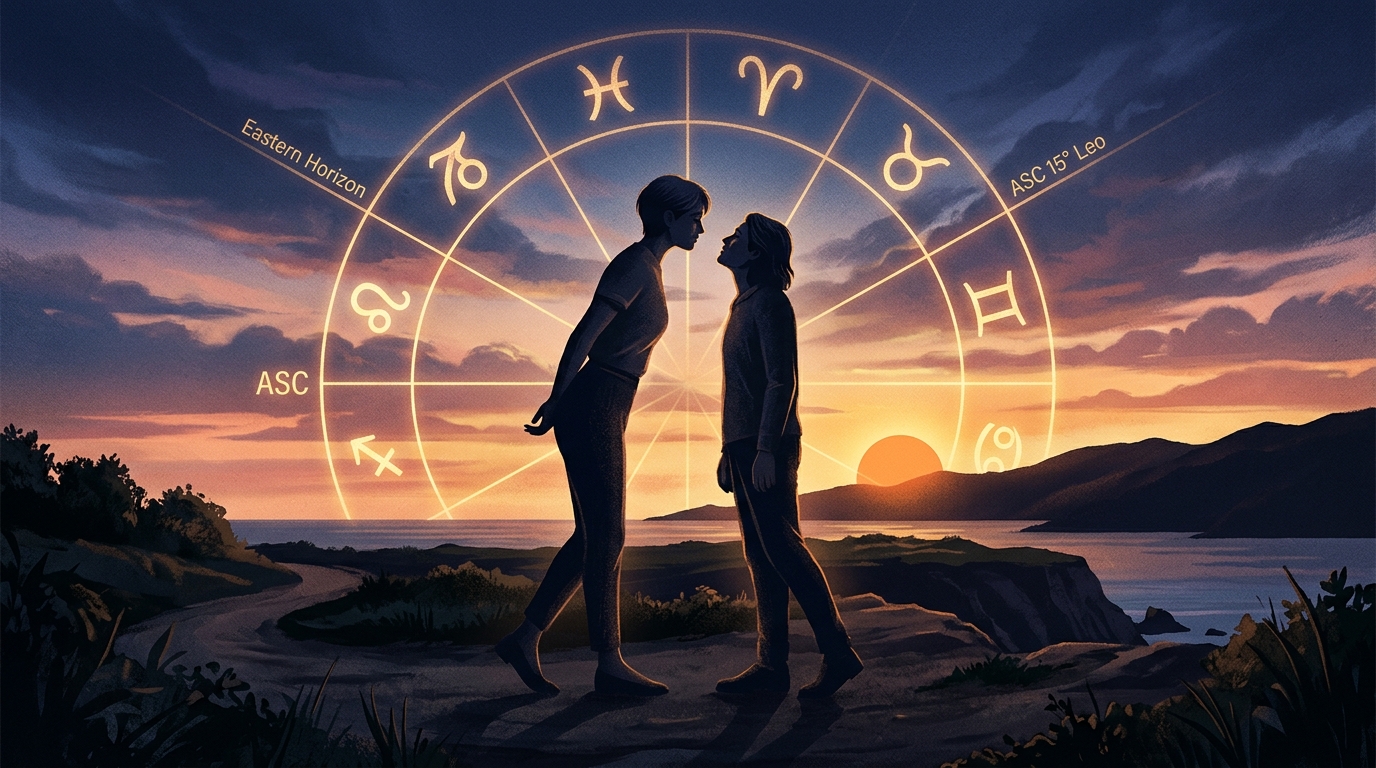
Most people check their Sun sign compatibility first. It's the obvious move — you know you're a Scorpio, they're a Taurus, you Google the pairing, and you get some version of "magnetic but volatile." What almost nobody checks is the Ascendant. And that's a problem, because the rising sign is what you actually encounter when you meet someone.
The Sun sign describes who you are at your core — your values, your will, your fundamental orientation toward life. But that depth takes time to surface. The Ascendant is what's visible from the first moment: how someone walks into a room, the energy they radiate before they've said a word, the physical and social impression they make. In relationship terms, the Ascendant governs attraction before the Sun sign even gets a chance to introduce itself.
What the Rising Sign Actually Is (Not What Most Articles Tell You)
The Ascendant is the zodiac sign that was rising on the eastern horizon at the exact moment of your birth. Because the Earth rotates, this point changes roughly every two hours — which is why birth time matters so much in astrology, and why two people born on the same day can have wildly different charts.
Most introductory articles describe the rising sign as your "mask" or "outer persona" — implying it's somehow less authentic than the Sun. That framing is misleading. The Ascendant isn't a performance. It's the lens through which you engage with the world, the body you inhabit, the instinctive social style you default to before conscious thought kicks in. It's not a mask so much as a membrane — the point where your inner world meets external reality.
In synastry (the comparison of two birth charts), the Ascendant carries enormous weight precisely because it operates at this immediate, physical level. It shapes posture, facial expressions, personal space habits, and the unconscious signals two people send each other. Understanding how the rising sign fits into the broader compatibility picture requires recognizing that it isn't competing with the Sun sign — it's operating in a completely different time zone of a relationship.
Why the Ascendant Governs Attraction Before Anything Else Does
The Physical and Energetic First Impression
When you meet someone, you're not reading their natal chart. You're reading their body. And the Ascendant governs the body — its shape, its movement patterns, its instinctive responses to other people.
Aries rising moves fast, takes up space, makes direct eye contact. Pisces rising drifts into a room with soft edges, eyes that seem slightly unfocused, a quality of being only partially present. Cancer rising tilts toward people protectively, reads the emotional temperature before speaking. These aren't stereotypes — they're the physical expression of the Ascendant operating in real time.
When two Ascendants are compatible, there's a physical ease that precedes any conversation about values or life goals. Bodies that move at the same rhythm, personal space preferences that match, eye contact that lands at the right intensity. This is what people describe when they say someone "just felt right" from the first meeting. They're usually describing Ascendant compatibility, even if they don't know it.
The Sun sign operates at a level that takes months to fully understand in another person. You don't know someone's core identity — their Virgo Sun's perfectionism, their Sagittarius Sun's restlessness — until you've seen them handle stress, make decisions, navigate conflict. The Ascendant is immediate. It's the first data point, and in attraction, first data points carry disproportionate weight.
Rising Sign Conjunctions: When Two People Feel Instantly Familiar
One of the most striking patterns in ascendant compatibility synastry is when two people share the same rising sign, or when one person's Ascendant conjuncts the other's. Astrologers consistently report that these pairings produce an unusual sense of recognition — the "have we met before?" feeling that has nothing to do with actual shared history.
The reason is structural. When your Ascendants match, you're literally encountering the world through the same lens. Your physical rhythms align. Your default social speeds are compatible. You occupy space in similar ways, which removes a constant low-level friction that most couples never even identify as a source of tension.
This doesn't mean identical Ascendants guarantee compatibility — Saturn, North Node, and Juno placements matter enormously for long-term durability. But in the early stages of a relationship, shared or harmonious Ascendants create a foundation of physical ease that Sun sign compatibility simply cannot replicate at that stage.
Rising Sign Compatibility by Element
The elemental framework — fire, earth, air, water — is the most practical entry point for understanding rising sign love compatibility across different pairings.
Fire Ascendants with Fire, Earth, Air, and Water
Aries, Leo, and Sagittarius rising share an energetic intensity and forward momentum. Two fire Ascendants together produce immediate chemistry — there's recognition, enthusiasm, a mutual willingness to take up space. The risk is that neither wants to yield, and the physical energy can tip into competition.
Fire with air (Gemini, Libra, Aquarius rising) is often the most naturally compatible pairing. Air feeds fire without competing with it. The air Ascendant brings mental stimulation; the fire Ascendant brings direction and warmth. In practice, these pairings tend to feel exciting without being destabilizing.
Fire with earth creates friction that can go either way. Earth Ascendants (Taurus, Virgo, Capricorn) move slowly and deliberately — the opposite of fire's impulsiveness. Initial attraction is possible (opposites do pull), but the day-to-day texture can feel exhausting for both.
Fire with water is the most complex pairing at the Ascendant level. Water rising (Cancer, Scorpio, Pisces) is porous, emotionally reactive, and sensitive to intensity. Fire's directness can feel aggressive to water; water's emotional depth can feel smothering to fire. This doesn't preclude compatibility — but it requires conscious adjustment.
Earth Ascendants: Who Grounds Them and Who Frustrates Them
Taurus, Virgo, and Capricorn rising share a physical groundedness, a preference for reliability, and a body language that communicates stability before words do. They're the people who seem solid the moment you meet them.
Earth with earth creates deep physical compatibility — similar pacing, similar comfort with silence, similar approaches to physical space. The potential downside is stagnation; two earth Ascendants can fall into routine so quickly that the relationship loses oxygen.
Earth with water is frequently cited as one of the most naturally supportive pairings in ascendant synastry. Water provides the emotional depth that earth can lack; earth provides the stability that water needs. The physical interaction tends to feel nurturing and calm.
Earth with air can be genuinely challenging at the Ascendant level. Air rising needs mental stimulation, novelty, and social variety — the things earth rising finds exhausting. This is a pairing where other chart factors (Venus, Moon, Mercury) need to compensate. Speaking of which, Mercury sign compatibility often determines whether these pairs can bridge the gap in daily communication.
Air Ascendants: The Need for Mental Stimulation in a Partner
Gemini, Libra, and Aquarius rising project an intellectual accessibility — they're approachable, often charming, and communicate ease from the first meeting. What they need in a partner, at the Ascendant level, is someone who can keep up.
Air with air creates immediate rapport and conversational flow. The risk is that both partners stay in their heads and avoid the emotional or physical depth that sustains long-term intimacy.
Air with fire, as noted, is one of the more naturally compatible elemental pairings. The fire partner provides energy and decisiveness; the air partner provides ideas and social intelligence.
Air with earth or water requires more negotiation. Earth's pace frustrates air; water's emotional demands can feel like a drain on air's social energy. These aren't deal-breakers — but they show up as friction in the texture of daily life, which is exactly the domain the Ascendant governs.
Water Ascendants: Emotional Permeability and the Right Kind of Partner
Cancer, Scorpio, and Pisces rising are the most energetically sensitive Ascendants. They absorb the emotional atmosphere of any room and respond to it — which means the emotional quality of a partner's Ascendant matters more to them than to most.
Water with water creates profound emotional attunement. Two water Ascendants can communicate volumes without speaking. The risk is mutual overwhelm — both partners absorbing each other's anxieties with no one providing a stable container.
Water with earth is the most consistently supportive pairing for water Ascendants. Earth provides the structure and calm that water needs; water provides the emotional warmth that earth often struggles to access on its own.
Water with fire or air can work, but requires the water Ascendant to develop resilience against fire's intensity and air's detachment. These pairings often produce initial fascination — the mystery of encountering someone so different — that fades as the day-to-day incompatibility of physical rhythms becomes apparent.
When Your Rising Signs Clash But Your Charts Are Actually Compatible
Here's the complication: rising sign compatibility is not the whole story. It's the opening chapter.
Two people with incompatible Ascendants can have deeply compatible charts overall. A Scorpio rising and a Gemini rising might find each other initially baffling — different paces, different social instincts, different physical presences. But if their Moons are conjunct, their Venus signs harmonize, and their composite chart shows strong relational indicators, the Ascendant friction becomes something they can work with rather than something that ends the relationship.
The key is understanding what the Ascendant friction actually is. It's not about values or compatibility at depth — it's about the physical and energetic interface between two people. That friction can be managed consciously. What's harder to manage is incompatibility at the Sun, Moon, or Venus level, because those operate at a level of identity that doesn't yield to awareness as easily.
Think of it this way: Ascendant incompatibility is like two people who walk at different speeds. Annoying, requires adjustment, but workable. Sun sign incompatibility at the core identity level is like two people who want to live in different countries. The scale of the problem is different.
This is why reading a synastry chart properly means looking at the full picture — not stopping at the Ascendant, but not dismissing it either.
The Catch: You Need a Birth Time to Find Your Rising Sign
The Ascendant changes signs every two hours. A person born at 6 AM and their twin born at 8 AM can have different rising signs entirely. This makes the rising sign the most time-sensitive point in the chart — and the most commonly unknown.
If you don't have a birth certificate with a recorded time, or a parent who remembers it precisely, you're working with uncertainty. Many people guess based on physical description or personality traits — a process called "chart rectification" — but this is genuinely complex work that requires comparing the chart against major life events.
What a Specialist Can Do When You Don't Have an Exact Time
An experienced astrologer can work backward from life events to narrow down the Ascendant. Major transitions — career changes, significant relationships, health events, relocations — all correspond to specific chart movements. By mapping these against potential Ascendant positions, a skilled practitioner can often identify the rising sign within a degree or two.
This isn't guesswork dressed up as astrology. Rectification is a legitimate and demanding technique that requires both technical skill and a detailed personal history. The result is a chart that actually reflects your life — which is the only kind worth using for compatibility analysis.
If you're serious about understanding how your Ascendant interacts with a partner's chart, the birth time question has to be resolved first. Ask an astrologer what your chart combination actually means — including whether your birth time is accurate enough to use the Ascendant with confidence.
The Sun sign tells you who two people are. The Ascendant tells you how they meet — and whether the meeting has a chance of becoming something more. For most couples, the quality of that first encounter sets a tone that persists long after the initial chemistry has settled into something quieter. Getting it right from the start isn't everything. But it's not nothing, either.